








Baranow Art at Russian House 2026: A Stand That Held the Room
A turquoise face, a sweep of gold, a classical head caught between fire and blue movement. The paintings at Baranow Art Gallery gave visitors several reasons to stop, and the arrangement gave them a reason to stay. At Russian House 2026, held at Moscow’s Gostiny Dvor on 7–9 October, the gallery presented one of the exhibition’s most compelling ensembles.
Founded by artist Walerij Baranow, the gallery brought together Igor Terekhin, Vyacheslav Gayun, Tatiana Danshina and Baranow himself, including works from his MESSAGE collection. Their differences gave the presentation its range. Across the walls, a richly worked surface could lead the eye towards a spare silhouette, while a familiar human face reappeared in a far less familiar setting.
A gallery within the exhibition
Russian House brought painting into contact with an audience already thinking about rooms, materials and the character of an interior. Baranow Art made an especially persuasive contribution to that conversation. Its display had the density of a small gallery, with larger canvases establishing the view from the aisle and smaller works rewarding a closer approach.
The hanging made colour a guide through the stand. Green and gold on one wall found an answer in ochre, red and deep blue elsewhere. White partitions kept the paintings legible beneath Gostiny Dvor’s high arches. Together, the works gave the compact space a breadth that exceeded any single view of the walls. The strength of the selection was that a visitor could enjoy the overall arrangement and still find a very different reason to concentrate on an individual work.
Igor Terekhin and the pull of colour
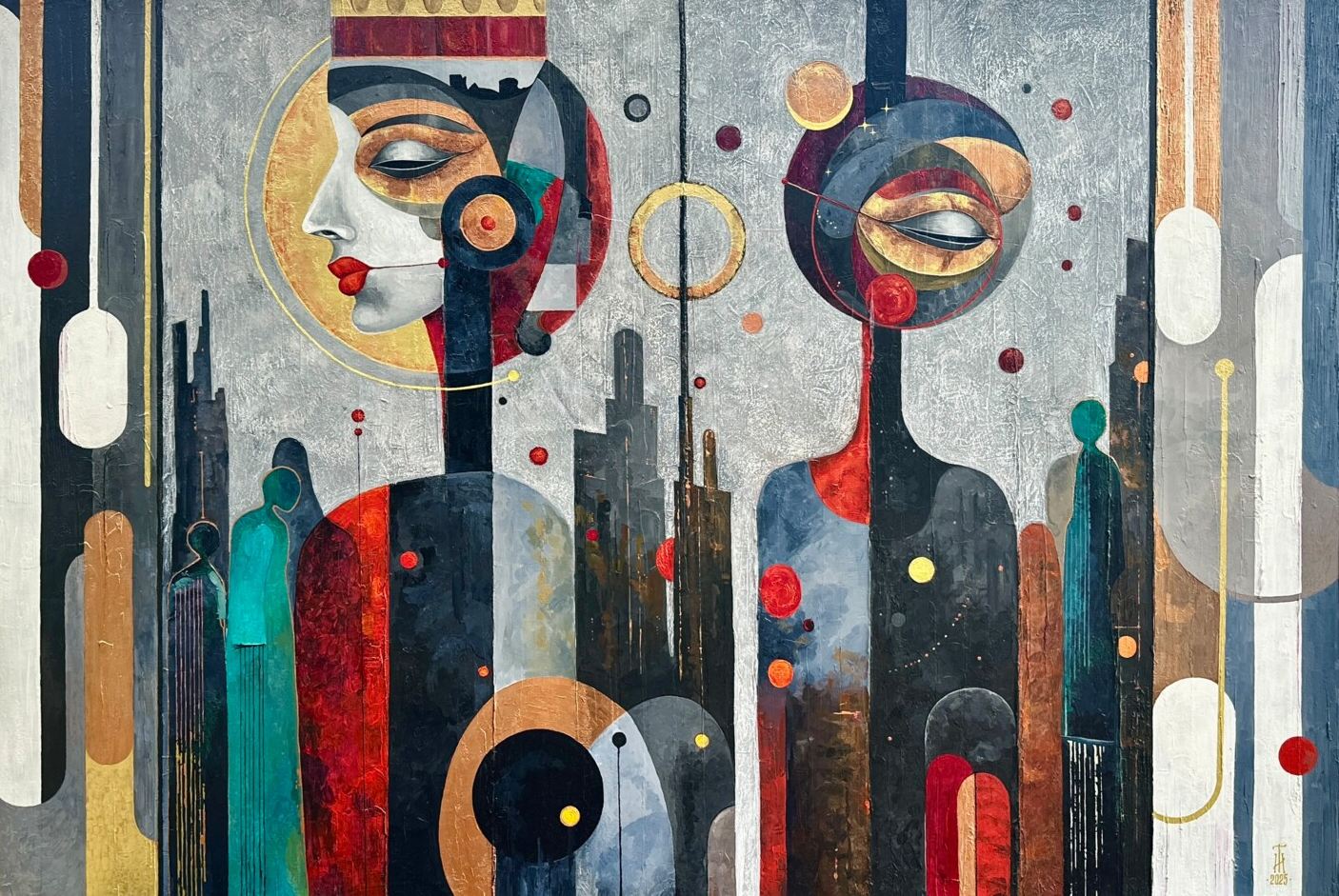
The contribution of Igor Terekhin was immediately recognisable. Turquoise, red and gold organised faces and figures into intricate compositions, with circles and intersecting planes carrying the eye across the surface. A face could emerge from that pattern and then almost disappear into it again. These were paintings that offered a strong first image without giving away everything at once.
Terekhin’s background includes ceramics, stained glass and Russian folk crafts, and that range offers an interesting context for his treatment of colour and ornament. At Russian House, the decorative richness had structure. Repeated forms held the compositions together, while the figures supplied an emotional presence within them. The effect was assured and unusually well suited to a display seen both from the aisle and at close quarters.
Vyacheslav Gayun and the confidence of a simple form
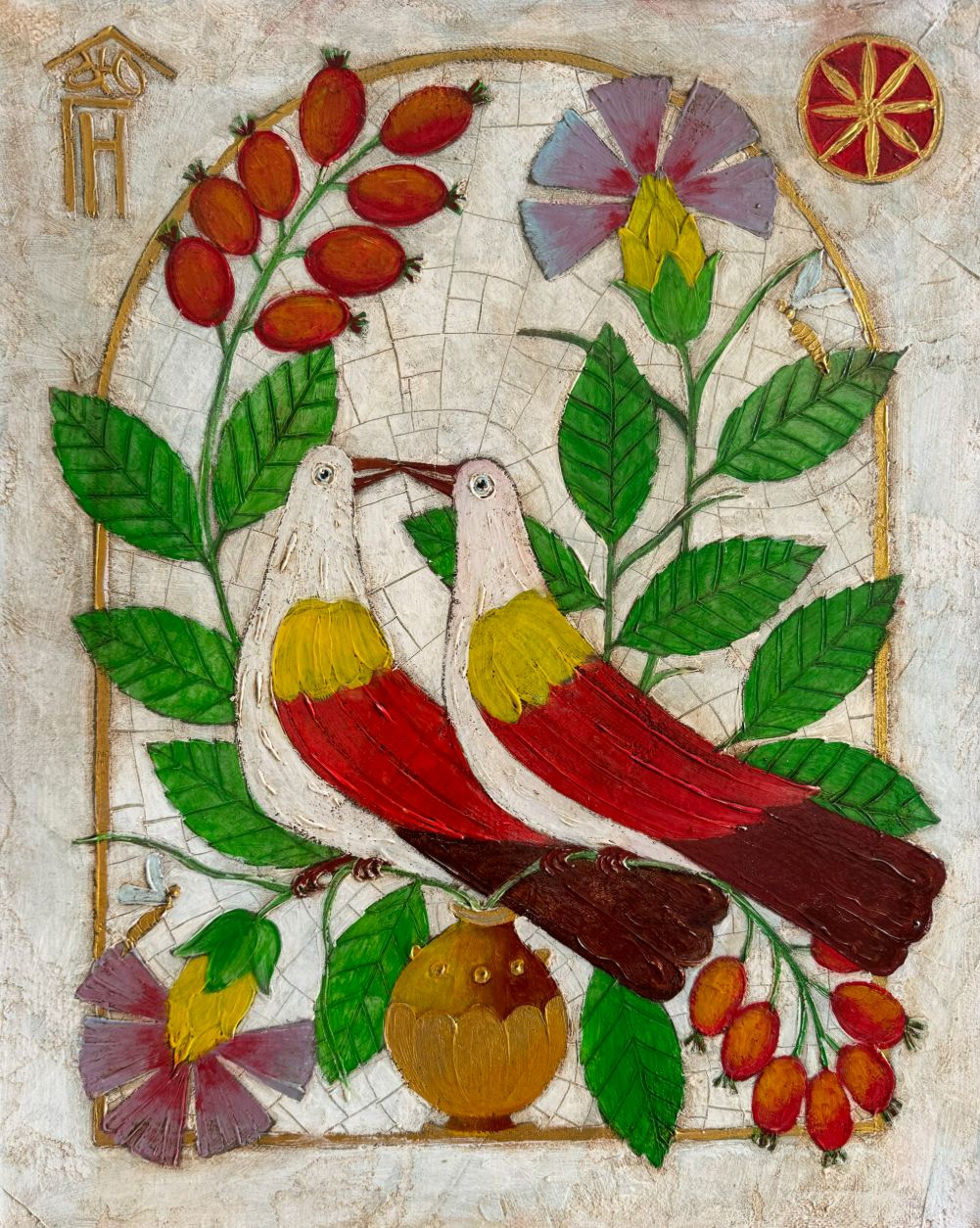
Vyacheslav Gayun changed the pace. His paintings gave a vessel, a curved shape or a line of leaves enough room to become the main event. Broad areas of colour and textured backgrounds made those apparently simple subjects feel substantial. The yellow and brown arcs, in particular, had a strong architectural presence on the wall.
That restraint was a valuable part of the gallery’s selection. After the intricacy of Terekhin’s figures, Gayun’s work invited the eye to settle on proportion, contour and the meeting of colours. His contribution showed how much a painting can do with a carefully judged interval or a single decisive shape. Within an interior exhibition, it was a convincing example of visual economy with personality.
Tatiana Danshina and the life of the surface
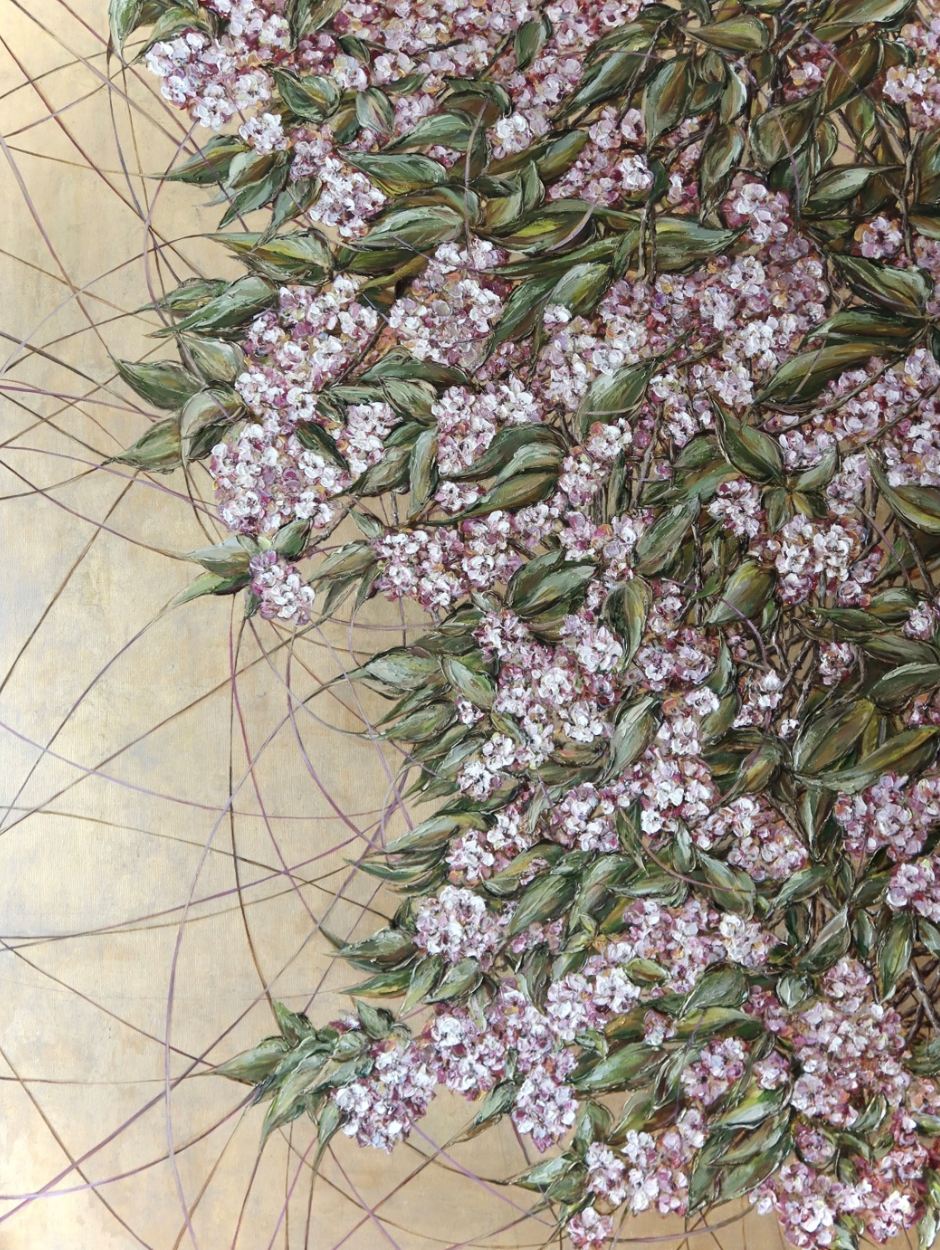
Tatiana Danshina (Danta) brought another kind of intensity. Her practice combines thickly applied oil paint with gold leaf, drawing on the forms and energy of nature. In the presentation, cascading foliage and red blossoms made the surface itself a major part of the encounter. The painted leaves seemed to gather weight as they descended across the luminous ground.
The appeal lay in the relationship between those two materials. Gold caught the light while the raised paint interrupted it, making the image more active than a flat reproduction could suggest. Danshina’s contribution gave the ensemble a particularly rich physical presence. It also introduced a different scale of attention: after taking in the whole composition, the viewer could follow the construction of a leaf or a cluster of flowers.
Walerij Baranow and the MESSAGE collection
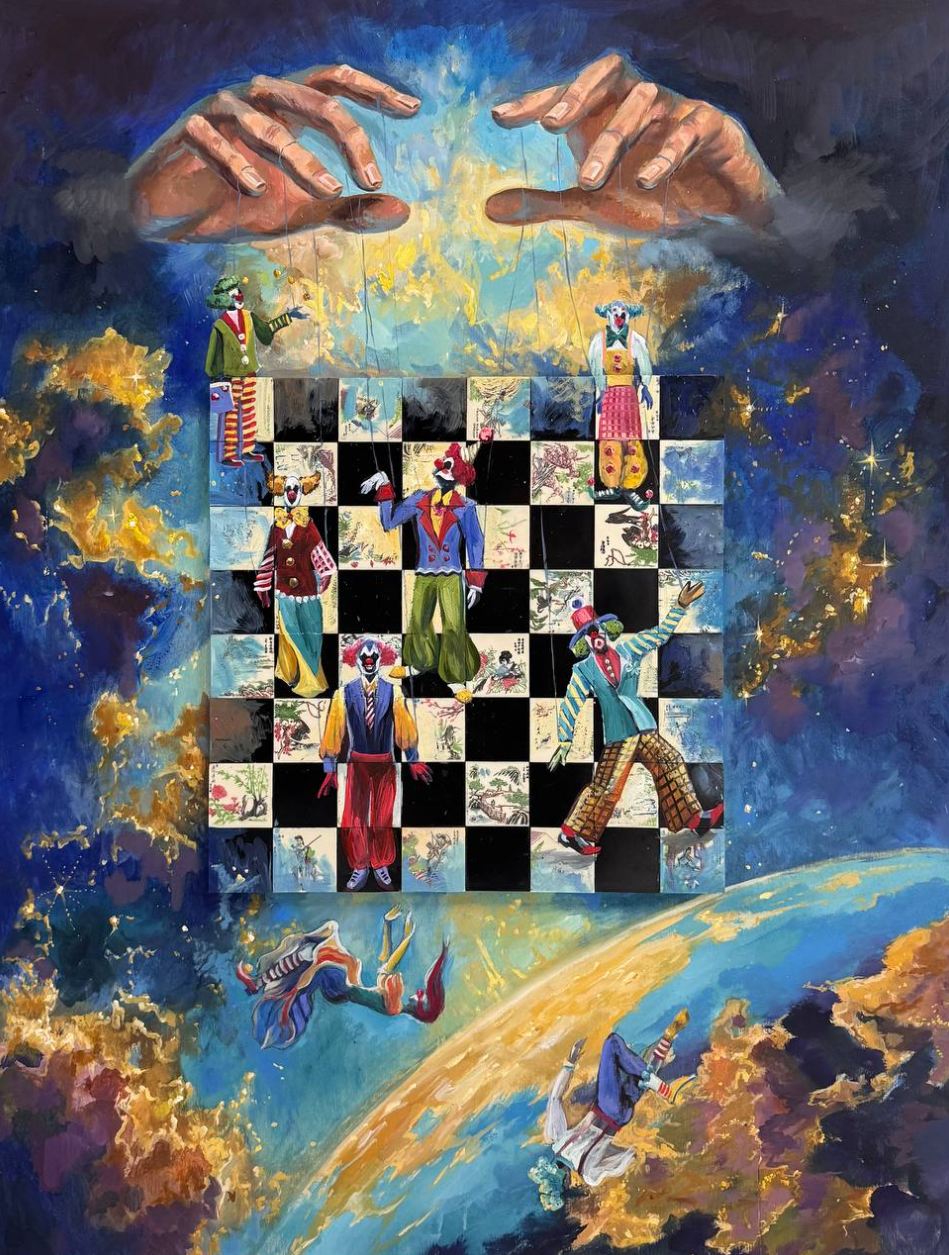
As both artist and gallery founder, Walerij Baranow occupied a distinctive place in the presentation. His work brought classical imagery into settings charged with movement and unexpected associations. Sculptural heads, fragments of the human figure and emphatic colour gave the back wall a theatrical force. Those recognisable forms made an immediate connection with the viewer, then opened into less settled stories.
The MESSAGE collection gave that encounter a further dimension. Conceived by Baranow as a limited collection of 100 individual art objects, the project treats a work as a personal statement carried through image and material. Its use of gold and its interest in symbolic meaning connect naturally with a setting in which visitors were considering what art can bring into a lived space.
At Russian House, that proposition had a tangible context. The paintings asked for attention through their surfaces, their scale and the relationships between their figures. MESSAGE made particular sense here because the idea of living with an artwork was already close at hand. A work could be chosen for the thought or association it kept returning to, as well as for the way it occupied a wall.
Editor’s Note
For ArtExpoWorld, Baranow Art’s presentation was one of the strongest at Russian House 2026 because the selection held together without flattening the artists’ differences. Terekhin’s intricate figures, Gayun’s measured forms, Danshina’s abundant surfaces and Baranow’s symbolic imagery each brought a distinct pleasure. The gallery gave those differences enough proximity to make them more vivid.
We especially appreciated the confidence of the hanging. There was plenty to see, yet the larger compositions established a clear rhythm and the changes of scale encouraged a closer look. The result felt generous. It allowed painting to command attention in its own right while showing how strongly it could shape the atmosphere around it.
That is the lasting impression of this presentation: a gallery with a recognisable eye, willing to put several expressive languages into the same room. Baranow Art made a persuasive case for all four artists and gave MESSAGE a setting in which its emphasis on personal meaning felt relevant. It was an exhibition contribution with the presence and cohesion to be remembered after the visit.