








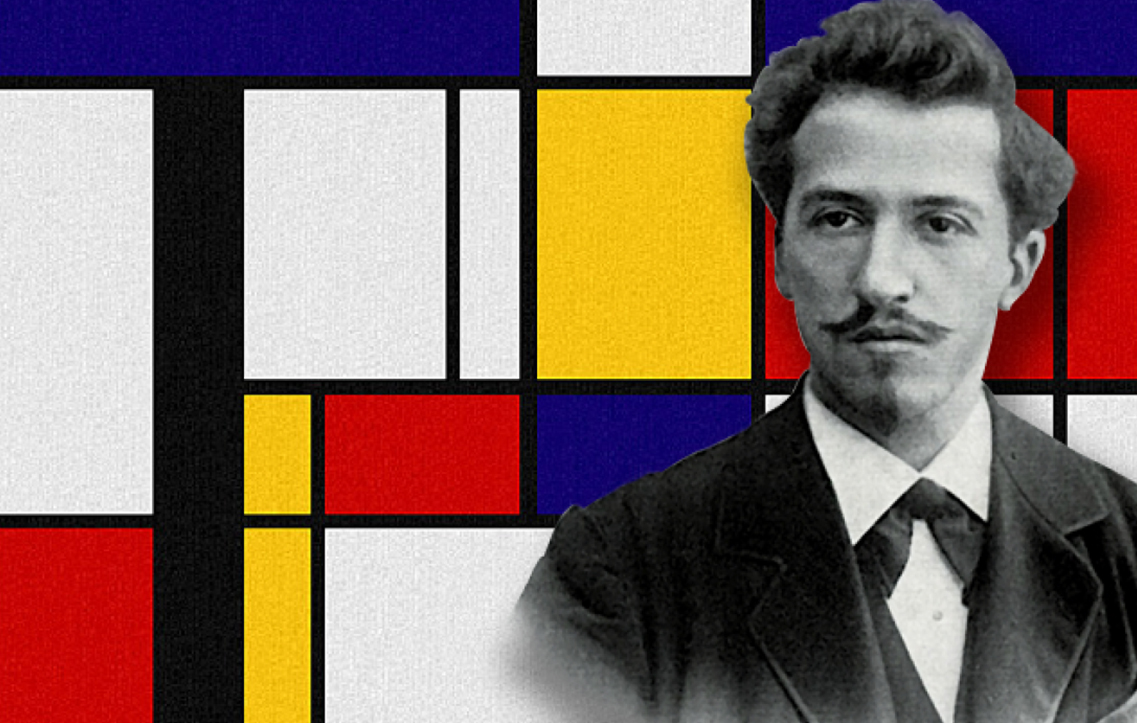
Piet Mondrian was one of the most influential pioneers of abstract art and one of the artists who most radically reduced painting to its fundamental elements. Vertical and horizontal black lines, white space, and carefully positioned fields of red, blue, and yellow became the foundation of a visual language that transformed not only painting but architecture, furniture, typography, fashion, graphic design, and modern visual culture.
Born in Amersfoort in the Netherlands in 1872, Mondrian did not begin his career as an abstract painter.
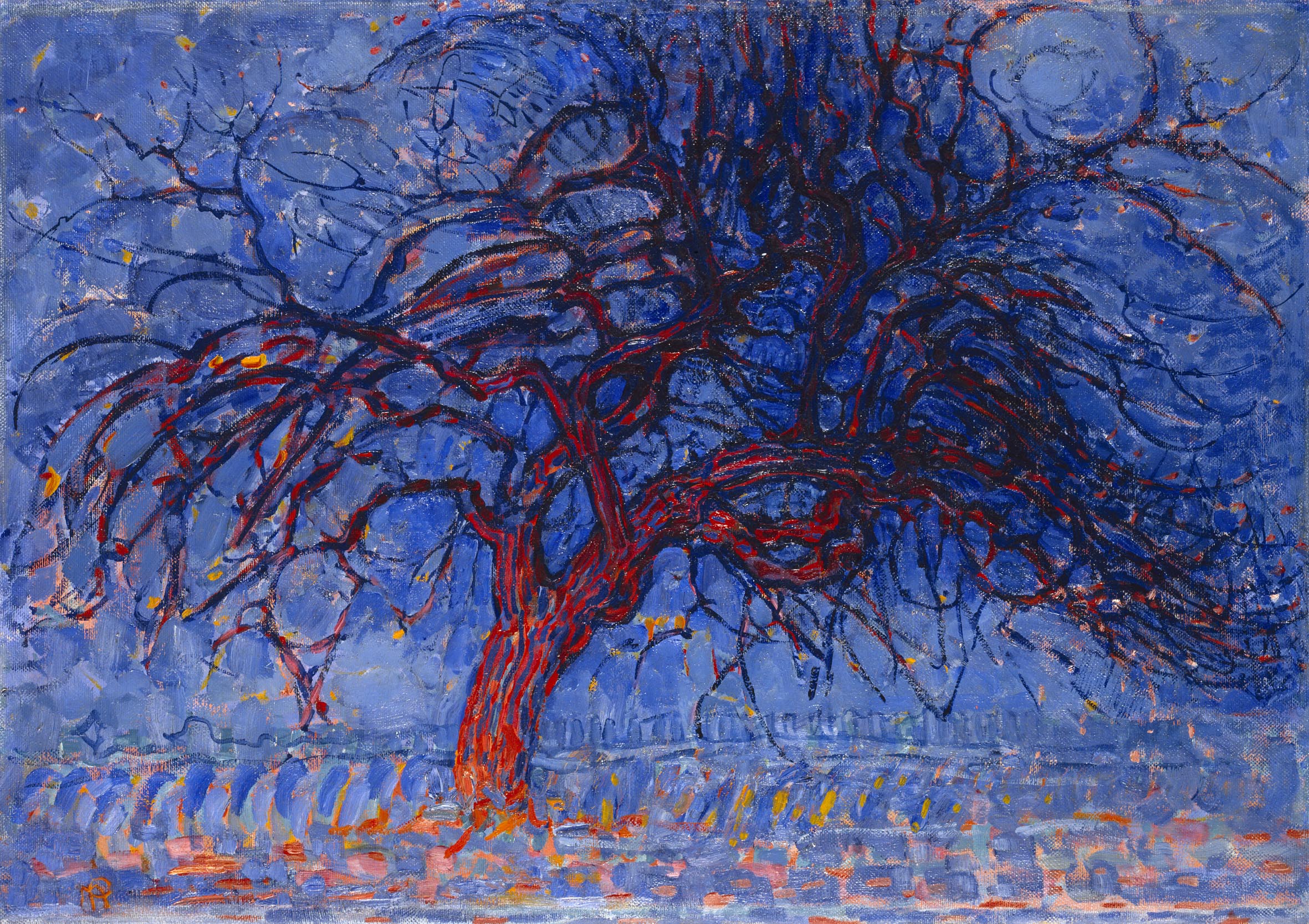
His early works include remarkably traditional landscapes, trees, farms, rivers, windmills, dunes, and evening skies.
This beginning is essential.
Mondrian’s abstraction did not emerge from a rejection of observation.
It developed through decades of increasingly intense analysis of the visible world.
He studied at the Rijksakademie in Amsterdam and became technically accomplished in conventional drawing and painting.
Dutch landscape initially provided his main subject matter.
Trees and windmills were especially important.
At first, these subjects appear naturalistic.
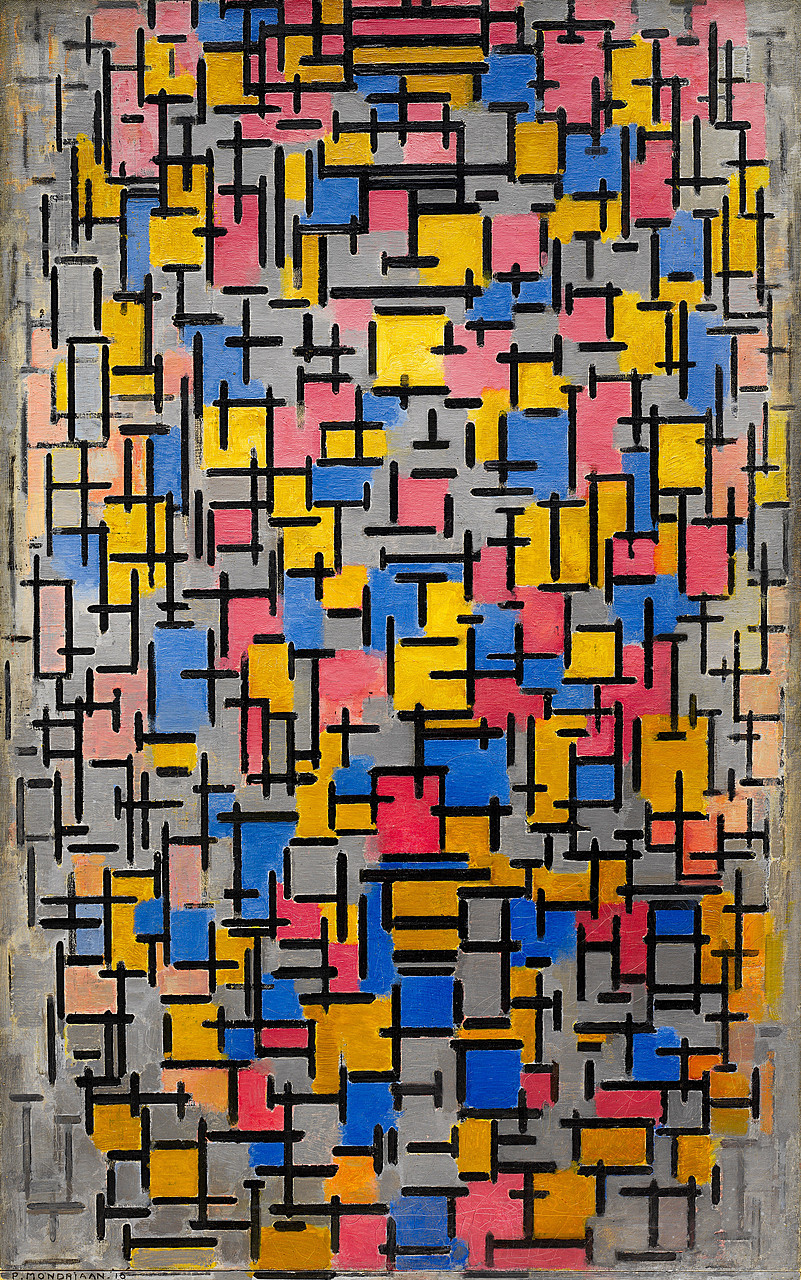
Gradually, Mondrian simplified them.
Branches became networks of lines.
Reflections became vertical and horizontal structures.
Fields and buildings became increasingly organized through broad areas of color.
The visible world begins to reveal an underlying geometry.
This transformation accelerated after Mondrian encountered modern developments including Post-Impressionism, Fauvism, and Cubism.
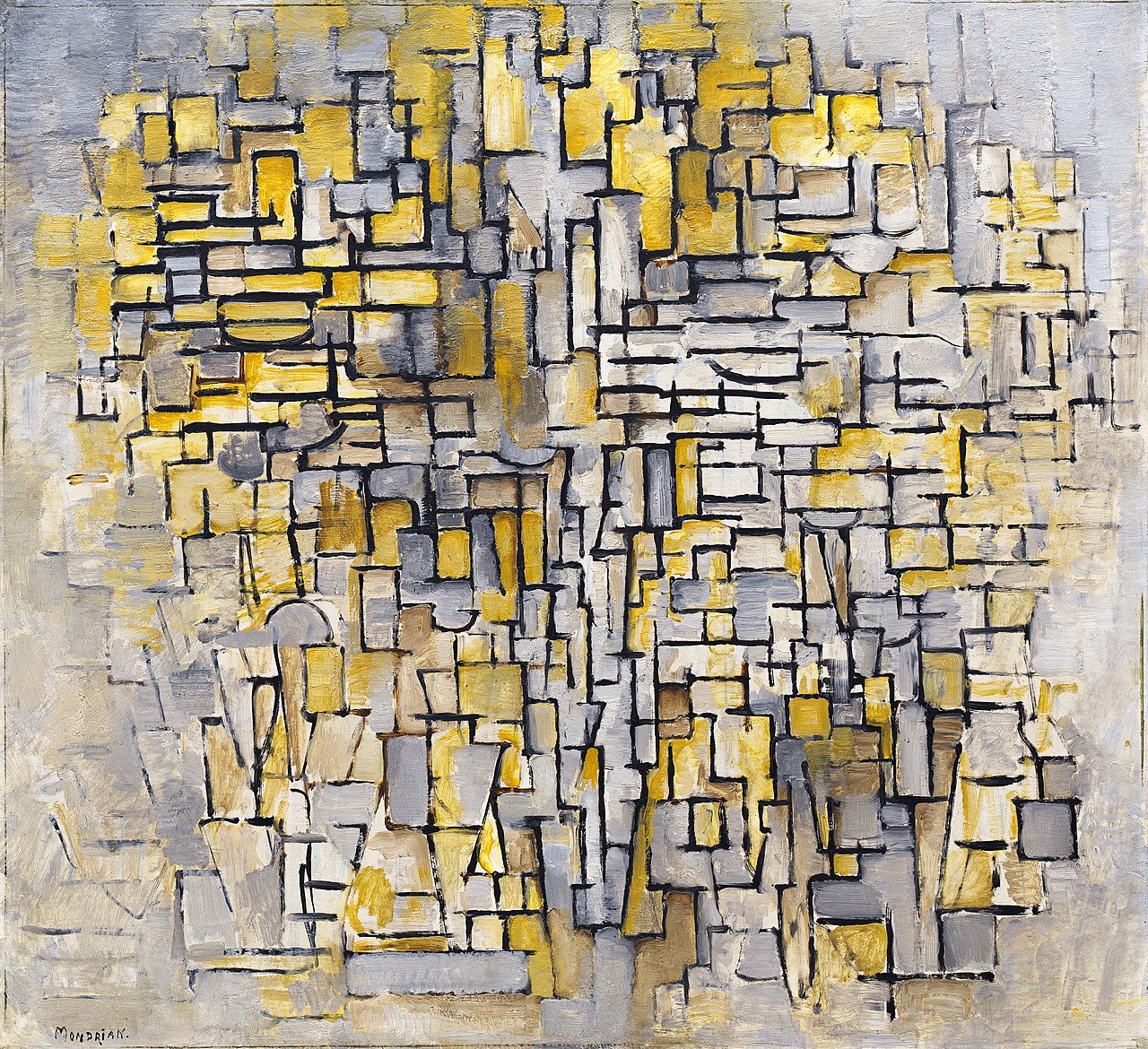
A move to Paris in 1911 placed him close to the radical experiments of Pablo Picasso and Georges Braque.
Cubism demonstrated that objects could be broken into structural planes and viewed from several perspectives.
Mondrian adopted aspects of Cubist fragmentation but eventually pushed the process further.
Picasso and Braque generally retained recognizable references to objects.
Mondrian increasingly removed them.
A tree could become a network.
Architecture could become intersecting lines.
Landscape could become rhythm.
He was searching for something more universal than the appearance of one particular place or object.
Spiritual and philosophical ideas played an important role in this development.
Mondrian was interested in Theosophy and broader attempts to identify universal principles beneath visible reality.
He believed that art could move beyond individual appearances toward fundamental relationships.
Opposition became essential.
Vertical and horizontal.
Positive and negative.
Color and non-color.
Individual element and total composition.
Mondrian did not see these oppositions as conflicts that needed one side to win.
Harmony emerged through their balance.
During the First World War, he remained in the Netherlands and became connected with artists and designers including Theo van Doesburg.
In 1917, Van Doesburg founded the journal De Stijl.
Mondrian became one of the movement’s central intellectual figures.
De Stijl sought a universal visual language based on reduction, geometry, and fundamental color relationships.
Painting was only one part of the project.
Architecture, furniture, interiors, typography, and design could follow similar principles.
Mondrian developed the theory he called Neo-Plasticism.
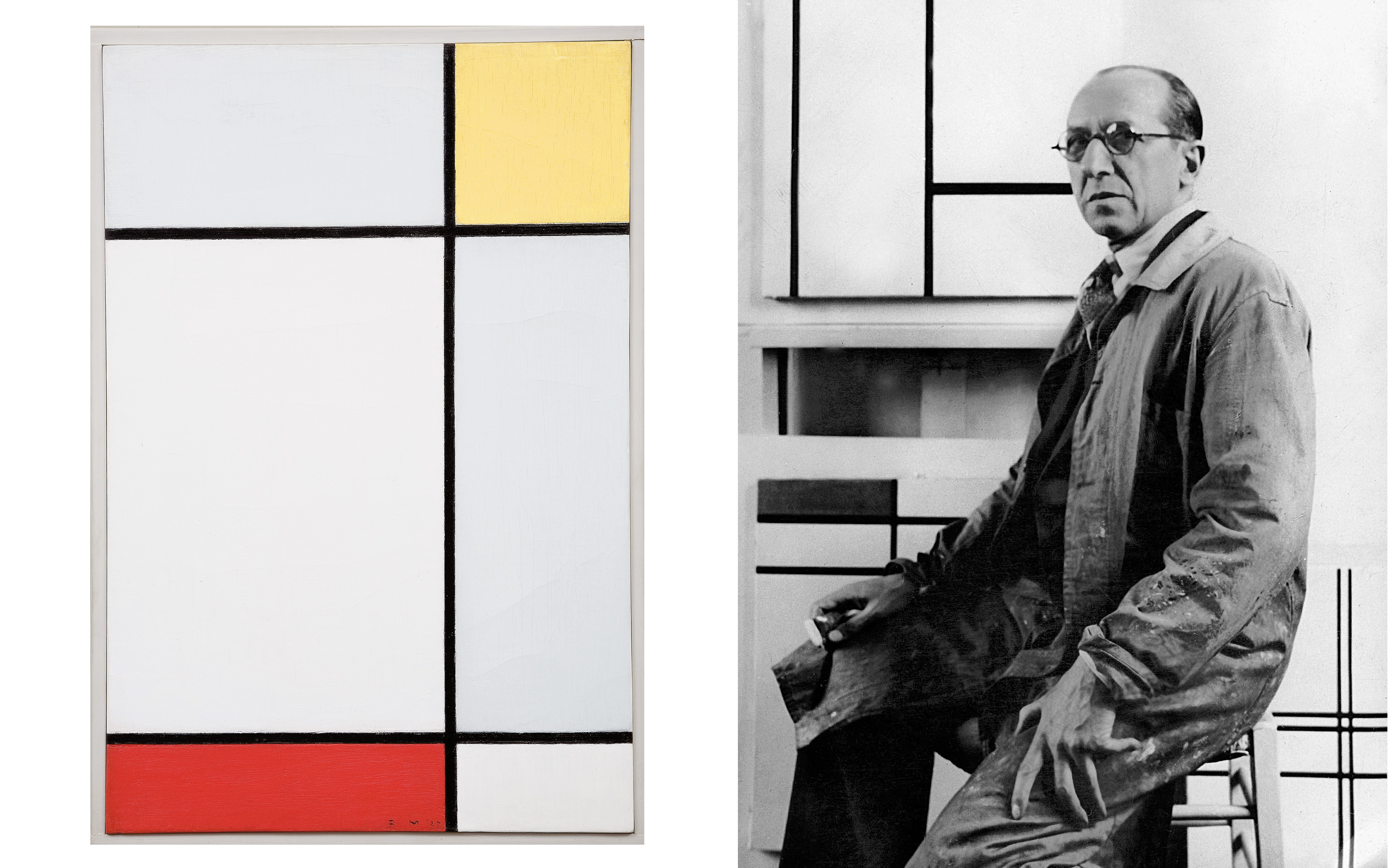
He progressively eliminated diagonal lines, naturalistic colors, curved forms, and recognizable imagery.
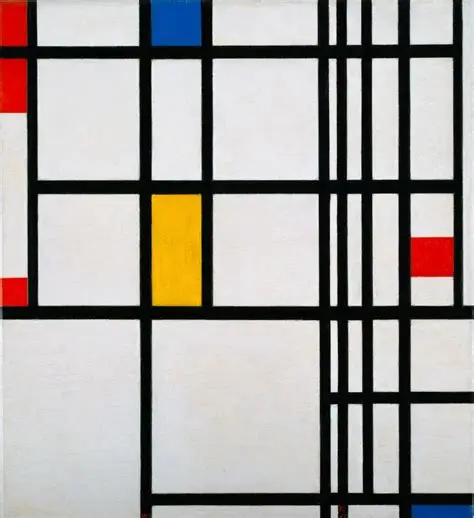
Black vertical and horizontal lines divided the canvas.
White or off-white fields occupied much of the surface.
Red, blue, and yellow appeared selectively.
The apparent simplicity is deceptive.
Mondrian’s paintings are not grids produced through a mechanical formula.
Lines vary in thickness.
Rectangles differ in scale.
Colors occupy carefully calculated positions.
Empty areas carry as much weight as painted ones.
The compositions frequently avoid conventional symmetry.
A large white field may be balanced by a tiny red rectangle.
A thick vertical line may interact with several thinner horizontal divisions.
The painting becomes a dynamic system.
Mondrian understood balance as something active rather than static.
Perfect symmetry would kill the tension.
His mature works therefore appear stable and unstable simultaneously.
Every element seems necessary.
Moving one rectangle or changing one line could alter the entire composition.
This extreme reduction forced viewers to become sensitive to relationships that conventional imagery often hides.
Without a face, tree, landscape, or story to interpret, attention moves toward proportion, interval, direction, color, and space.
Mondrian made relationships themselves the subject of painting.
His studio became an extension of this artistic philosophy.
Photographs of his Paris and New York studios show walls organized with colored rectangles and geometric arrangements.
The environment was not simply a place where paintings were produced.
It functioned as a three-dimensional experiment in Neo-Plastic relationships.
Mondrian could reposition colored elements and observe how the entire room changed.
This practice anticipated installation and environmental approaches that became increasingly important later in contemporary art.
His relationship with architecture was equally significant.
De Stijl designers translated similar principles into buildings and furniture.
The most famous architectural examples associated with the movement demonstrate how planes, lines, and primary colors could move from canvas into physical space.
Mondrian himself remained primarily a painter, but his ideas provided a visual grammar that architects and designers could adapt.
His disagreement with Theo van Doesburg eventually became famous.
Van Doesburg began introducing diagonal lines into his work.
Mondrian considered the diagonal incompatible with the equilibrium he was trying to achieve.
The dispute contributed to their separation.
To an outside observer, arguing over a diagonal line may appear absurdly minor.
Within Mondrian’s system, however, it was fundamental.
He was not choosing shapes according to taste.
He was constructing a complete philosophy of visual relationships.
Political events repeatedly displaced him.
The rise of Nazism and the approach of the Second World War eventually pushed Mondrian from Paris to London and then to New York.
New York transformed his late work.
The city’s grid, traffic, architecture, lights, music, and extraordinary energy offered a physical environment strangely compatible with the visual system he had spent decades developing.
Jazz, particularly boogie-woogie, became important.
Mondrian loved dancing and modern music.
Rhythm had always been present in his compositions, but New York encouraged a new level of visual movement.
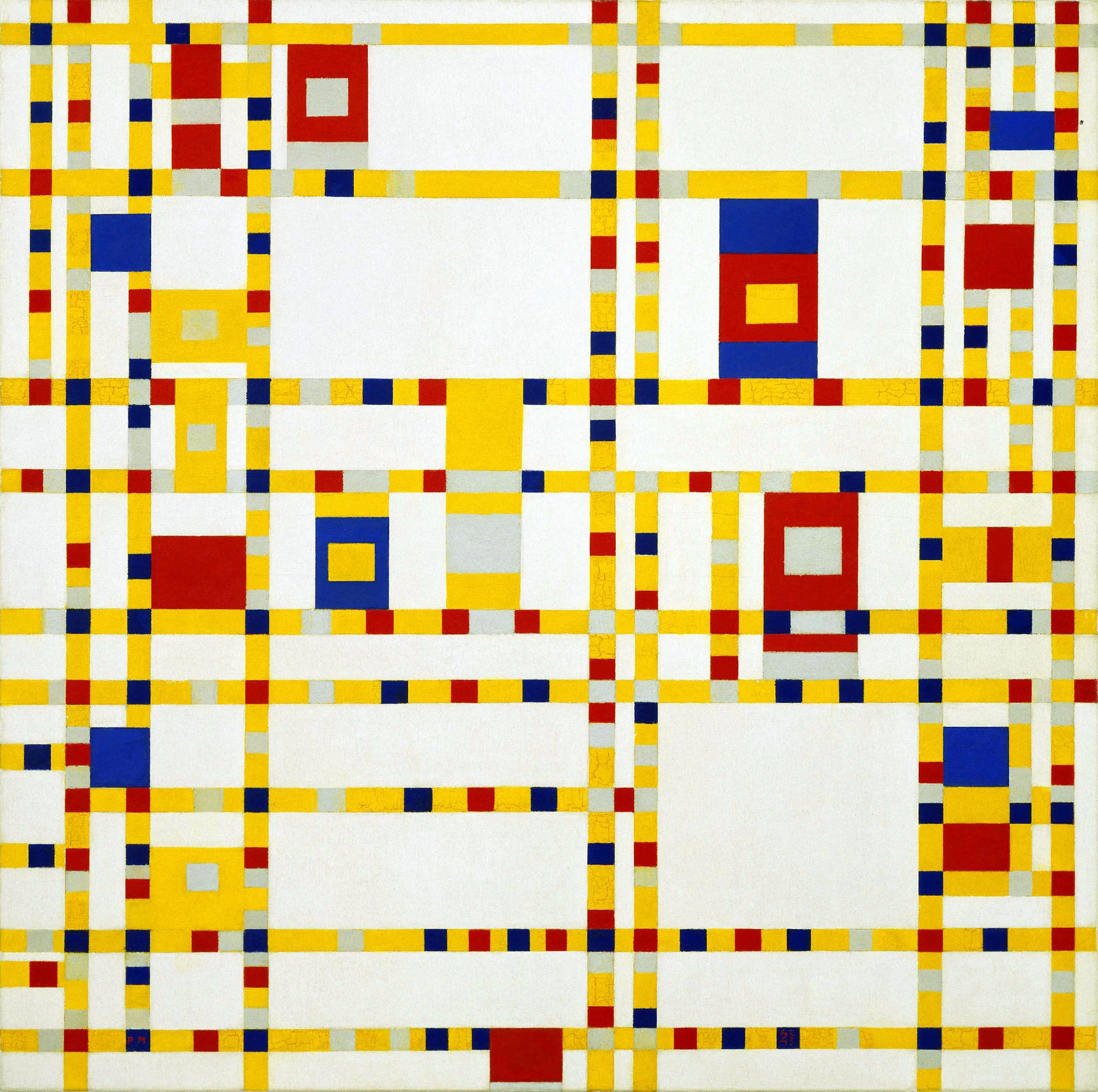
Black lines began disappearing.
Instead, colored lines constructed the grid.
Small blocks of red, blue, yellow, gray, and white create syncopated rhythms.
Broadway Boogie Woogie, completed in 1942–43, became the defining painting of this final phase.
The title connects Manhattan’s street grid with the rhythmic structure of boogie-woogie music.
Tiny colored blocks move across intersecting lines like lights, traffic, musical beats, or pulses of urban energy.
The painting remains completely abstract.
Yet it also feels unmistakably connected to New York.
Mondrian achieved something remarkable.
After decades spent removing references to visible reality, he discovered a way for abstraction to evoke a specific city without representing a single building.
His final unfinished work, Victory Boogie Woogie, pushed this fragmentation even further.
Small pieces of colored tape allowed him to adjust relationships rapidly while working.
The painting reveals an artist still experimenting at the end of his life.
Mondrian died in New York in 1944.
His influence expanded enormously after his death.
Minimalism, geometric abstraction, architecture, industrial design, typography, advertising, fashion, and digital interfaces all absorbed aspects of his visual language.
One of the most famous examples came through fashion when Yves Saint Laurent created dresses inspired by Mondrian’s compositions during the 1960s.
The translation seemed natural because Mondrian had already reduced painting to relationships capable of moving between different surfaces and objects.
His influence is now so widespread that black grids and primary colors can appear almost generic.
That familiarity creates a problem.
It is easy to look at Mondrian today and assume the paintings are simple because contemporary visual culture has absorbed their language.
Historically, the opposite is true.
Reaching this level of reduction required decades.
Mondrian began with trees.
He studied branches.
He simplified them.
He encountered Cubism.
He removed volume.
He removed curves.
He reduced color.
He eliminated recognizable objects.
Only after this long process did the famous grid emerge.
The mature paintings are therefore not the beginning of his investigation.
They are the result.
At ArtExpoWorld, we consider Piet Mondrian one of the clearest examples of how radical simplification can transform visual culture.
He demonstrated that painting does not require recognizable imagery to create tension, movement, balance, and emotion.
A red rectangle can affect an entire canvas.
A black line can create direction.
An empty white field can become active space.
Mondrian’s greatest achievement was not inventing a recognizable style.
It was proving that relationships between basic visual elements could become a complete artistic language.
That language escaped the canvas and entered the modern world.
Buildings, furniture, magazines, clothing, websites, packaging, logos, and digital screens continue to use principles that Mondrian helped make visible.
Few painters have influenced the designed environment so profoundly.
Piet Mondrian spent his career removing everything he believed was unnecessary.
What remained was not emptiness.
It was structure.