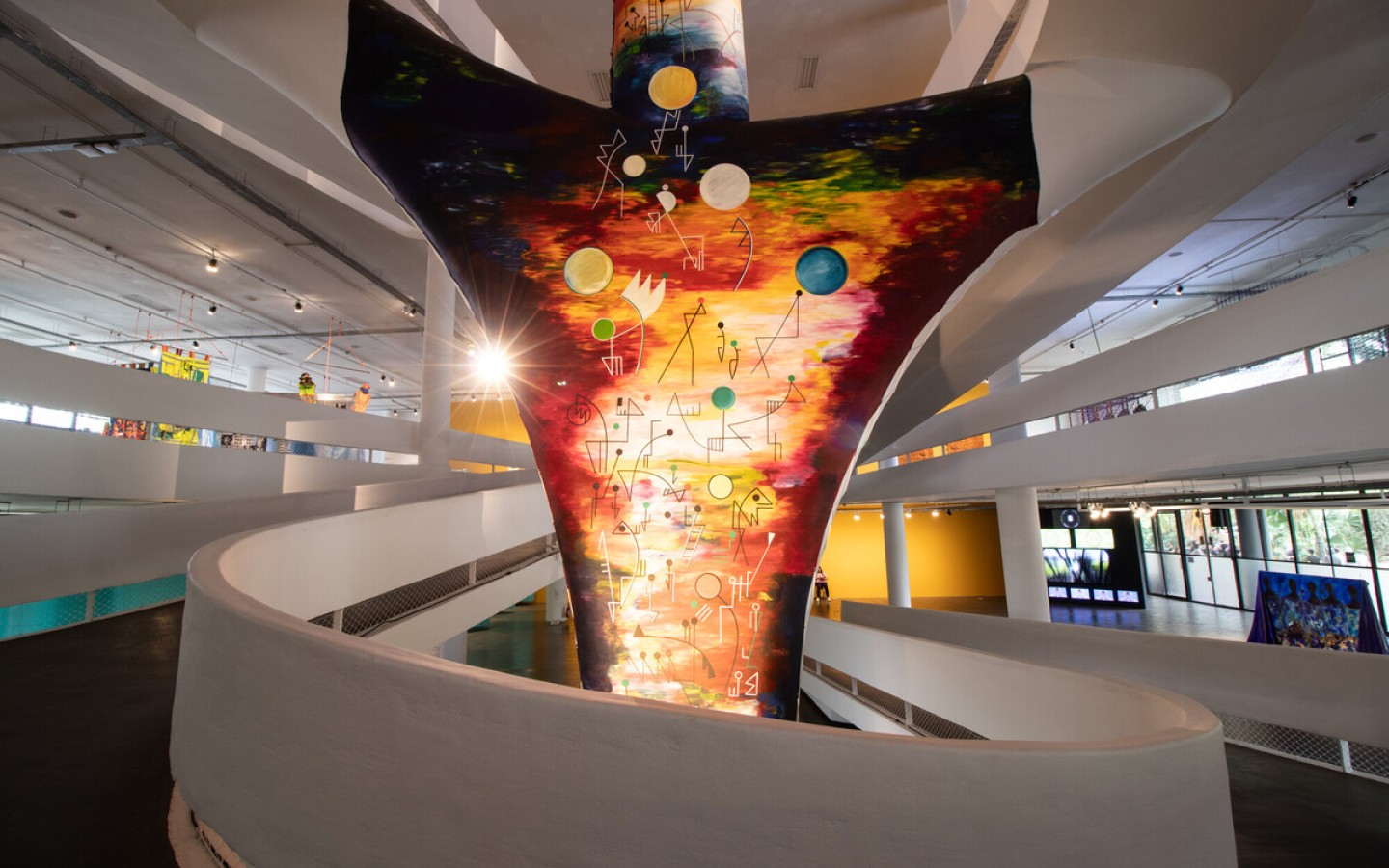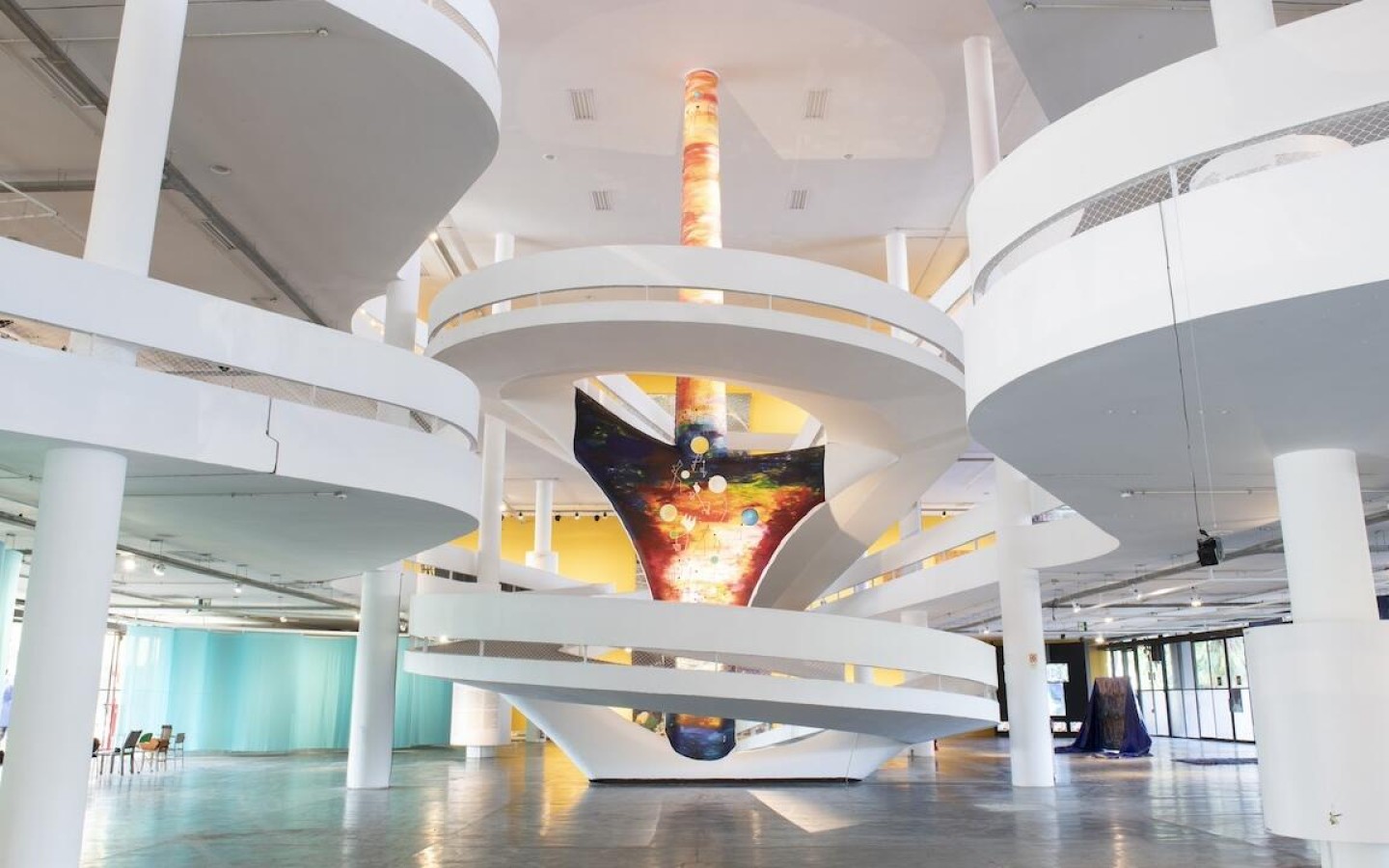

The 36th São Paulo Biennial arrives in Santiago in 2026 with a focused international exhibition at Centro Cultural La Moneda.

Open from 3 July to 4 October, the presentation brings together works by 19 artists from Brazil and other parts of the world. The exhibition is installed in Sala Andes, one of the main gallery spaces beneath Plaza de la Ciudadanía in central Santiago.

The exhibition is titled Not All Travellers Walk Roads – Of Humanity as Practice. It is a selected touring presentation from the 36th Bienal de São Paulo, which originally took place in the Ciccillo Matarazzo Pavilion in São Paulo from September 2025 to January 2026.

Visitors should therefore understand the Santiago event as a new interpretation of the original biennial rather than a full reconstruction of it.

The exhibition explores humanity not as a fixed biological identity or universal condition, but as something continuously created through actions, relationships, listening, negotiation, and encounters between different people and communities.

Its themes include migration, belonging, colonial histories, environmental relationships, cultural memory, resistance, and the ways individuals learn to coexist across political and social boundaries.

Admission is free, making the exhibition one of the most accessible major international contemporary art events in Santiago during 2026.

For ArtExpoWorld readers, the exhibition offers an opportunity to engage with ideas and artists from one of the world’s most influential biennials without traveling to Brazil.

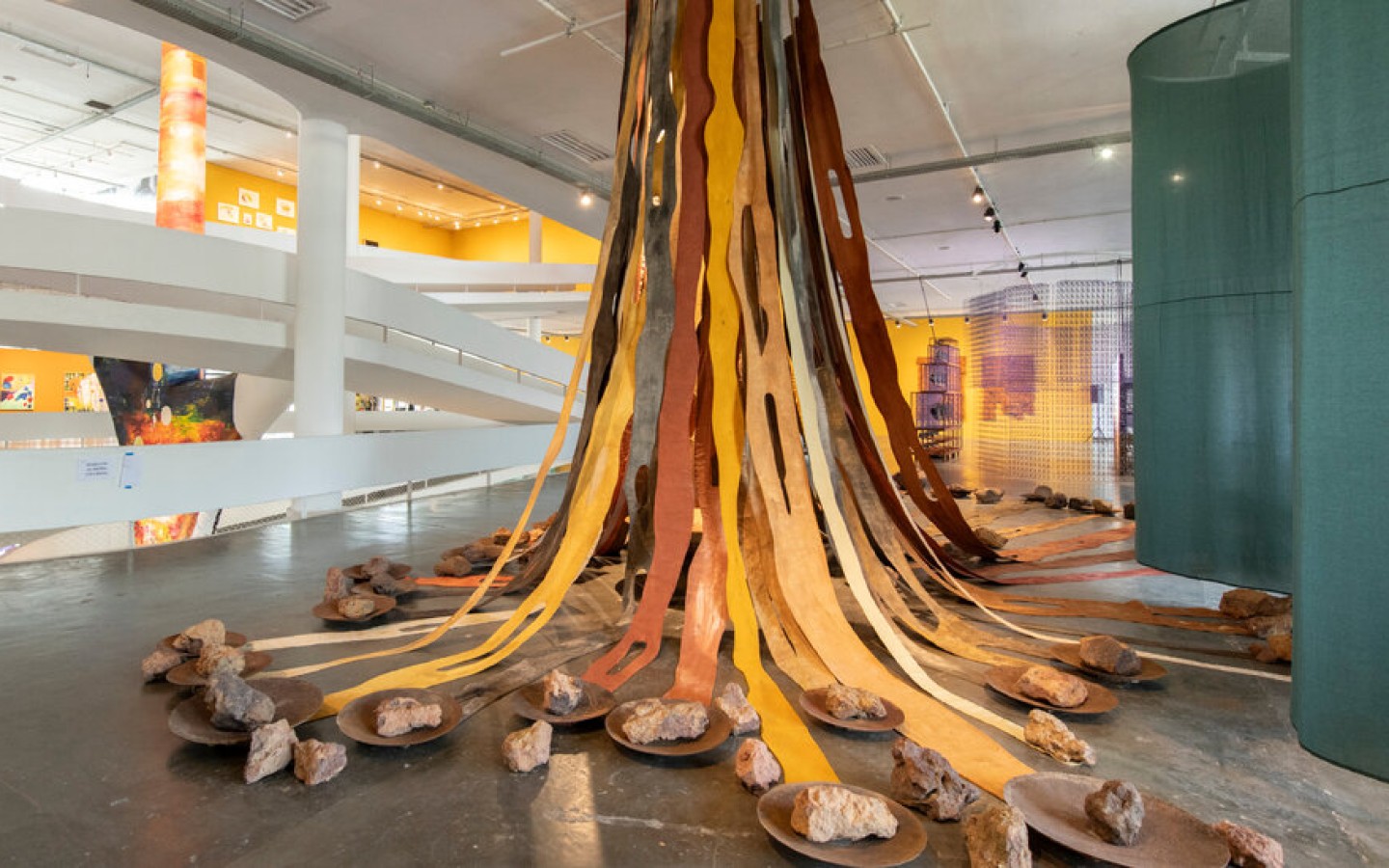
The Santiago presentation includes works by 19 artists selected from the wider programme of the 36th Bienal de São Paulo.

The artists come from different countries, generations, and cultural traditions. Their work includes photography, painting, textile art, installation, archival research, sculpture, and interdisciplinary practice.

The exhibition has been adapted specifically for Sala Andes at Centro Cultural La Moneda.

Rather than attempting to reproduce the enormous scale of the original São Paulo event, the curators have created a focused presentation that preserves its central questions while responding to the cultural and political context of Chile.

The exhibition explores how identities are shaped through movement, displacement, language, land, and collective memory.

Several artists investigate histories that have been hidden, ignored, or deliberately erased. Others examine the relationship between people and territory, including the environmental, spiritual, and political meanings attached to land.

Photography and archival material play an important role in the exhibition. They are used not only to document events but also to question who creates historical records, whose experiences are preserved, and whose stories remain invisible.

The works also reflect on the legacies of colonialism and the continuing inequalities produced through race, class, migration, and access to political power.

Despite the seriousness of these subjects, the exhibition is not based solely on conflict or trauma.
It also considers imagination, beauty, ritual, solidarity, and artistic creation as ways of building relationships and imagining different futures.

36th São Paulo Biennial in Santiago 2026 Event Overview

36th São Paulo Biennial in Santiago 2026 – Touring Exhibition in Chile

This is only the second time that the official touring programme of the Bienal de São Paulo has reached Chile. The 2026 presentation forms part of a wider programme taking selected works and curatorial ideas from the 36th edition to 15 cities in Brazil and abroad.

Dates:

3 July 2026 - 4 October 2026

Location:

Sala Andes, Centro Cultural La Moneda, Santiago, Chile

Mission:

The mission of the 36th São Paulo Biennial touring exhibition in Santiago is to rethink what it means to practise humanity. The exhibition proposes that humanity is not something people automatically possess. It is something expressed through the ways individuals listen, care, communicate and respond to others. This approach challenges the idea that one universal model can represent every culture, community or historical experience. Instead, the exhibition presents humanity as relational and situated. It develops differently according to place, memory, language, environment and social conditions. Another important purpose of the touring programme is to extend the conversations of the São Paulo Biennial beyond its original pavilion. When works move to Santiago, they enter into dialogue with Chilean histories of dictatorship, migration, Indigenous identity, political resistance, social inequality and environmental conflict. The exhibition also aims to make international contemporary art available to a broad public. Free admission allows students, families, artists and visitors without specialist art knowledge to experience the project. The wider mission is not to provide simple answers. It is to create a space where different histories and forms of knowledge can meet without being forced into one dominant narrative.

Organizer:

The touring exhibition is organised by Fundação Bienal de São Paulo in collaboration with Centro Cultural La Moneda. The chief curator of the 36th Bienal is Bonaventure Soh Bejeng Ndikung. The conceptual curatorial team for the original edition also included Alya Sebti, Anna Roberta Goetz and Thiago de Paula Souza. Keyna Eleison served as co-curator at large, while André Pitol and Leonardo Matsuhei worked as deputy co-curators. For the Santiago presentation, the curatorial adaptation is led by Bonaventure Soh Bejeng Ndikung with André Pitol. The exhibition architecture is designed by Tiago Guimarães. The partnership allows artworks and debates developed in Brazil to enter into conversation with Chilean audiences and institutions.

Why attend to 36th São Paulo Biennial in Santiago 2026?

The exhibition is worth visiting because it provides access to a carefully selected part of one of the world’s leading contemporary art biennials.

For visitors who could not attend the original presentation in São Paulo, the Santiago exhibition offers an opportunity to encounter its central ideas and several significant artists.

For students and researchers, the exhibition provides material related to decolonial thought, migration, race, environmental politics, and the relationship between art and historical evidence.

For photographers and filmmakers, the presentation includes important examples of documentary, poetic, and politically engaged image-making.

For artists, it demonstrates how personal and local experiences can be connected with wider international conversations without losing their cultural specificity.

For cultural travellers, the exhibition can be combined with Santiago’s museums, historic districts, architecture, and contemporary gallery scene.

Free admission also makes repeat visits possible. Some works may require more than one encounter to fully understand their historical and conceptual context.

Ticket Information

General admission costs

Admission to the 36th São Paulo Biennial touring exhibition in Santiago is free.

Visitors do not need to purchase a paid entrance ticket.

Centro Cultural La Moneda operates a free online reservation system for the exhibition.

A reservation is issued for a selected date and can be used once during that day.

Visitors should keep the reservation confirmation available on their phone or as a printed document.

Walk-in access may be possible when capacity allows, but advance booking is the safer option for weekends, guided programmes and busy periods.

Separate activities, workshops or special events may require additional registration even when the main exhibition is free.

Getting There:

Centro Cultural La Moneda is located at Plaza de la Ciudadanía 26 in central Santiago.

The cultural centre is situated beneath the civic square next to Palacio de La Moneda.

The easiest public transport option is Metro Line 1.

Visitors should exit at La Moneda station, which is only a short walk from the cultural centre.

Pedestrian access is available through the civic plaza and Morandé Street.

Numerous city bus routes also serve the surrounding government and central business district.

Taxis and rideshare services can drop visitors close to the entrances, although road closures and official events may occasionally affect access around the presidential palace.

Private paid parking is available through the SABA parking facility, with vehicle access from Teatinos Street.

International visitors normally arrive through Arturo Merino Benítez International Airport.

Airport buses connect the terminals with central Santiago, while taxis, authorised transfers and rideshare services provide direct transport.

Travel time depends on traffic, particularly during weekday mornings and evenings.

Accessibility

Centro Cultural La Moneda provides lifts at both entrances and between its interior levels.

Manual wheelchairs are available free of charge from the admissions desk on Level -1, subject to availability.

The underground exhibition halls can be reached without using stairs.
Visitors requiring additional assistance should contact the cultural centre before travelling or speak with staff on arrival.

Free admission applies to the exhibition, although advance reservation may still be advisable for visitors and accompanying persons.

Accommodation

Central Santiago is the most convenient area for visitors who want to stay close to Centro Cultural La Moneda.

The neighbourhood provides access to historic buildings, government architecture, museums and Metro Line 1.

Lastarria is a strong choice for cultural travellers. It offers galleries, museums, restaurants, cafés and access to Cerro Santa Lucía.

Bellavista may appeal to visitors interested in nightlife, street art and a more informal creative atmosphere.

Providencia provides a wider selection of hotels, restaurants and transport connections while remaining within easy metro reach of the exhibition.

Barrio Italia offers independent design stores, cafés and restaurants in a more residential environment.

Las Condes has modern international hotels and business facilities but is farther from the historic centre.

Visitors planning to explore several cultural districts should choose accommodation close to a Metro Line 1 station.

Gallery: 36th São Paulo Biennial in Santiago 2026

Secure Your Spot at 36th São Paulo Biennial in Santiago 2026 — Before It's Too Late

Tickets are limited and sell out fast.
Get instant access to the 36th São Paulo Biennial in Santiago 2026 registration page and be the first to know about exclusive events, VIP passes, and travel perks.

Early access. Limited availability. Global art at your fingertips.

History & Context of a 36th São Paulo Biennial in Santiago 2026

The Bienal de São Paulo was created in 1951 and became one of the first major international art biennials established outside Europe.

Its original ambition was to bring Brazilian modern art into direct contact with artistic developments from other parts of the world.

Over subsequent decades, the Bienal became one of the largest and most influential contemporary art exhibitions in the Southern Hemisphere.

It has introduced Brazilian audiences to major international movements while also helping Latin American artists gain wider recognition.

Fundação Bienal de São Paulo was formally established in 1962 as the independent, nonprofit institution responsible for organising the event.

The main biennial is traditionally held in the Ciccillo Matarazzo Pavilion in Ibirapuera Park, an important modernist building designed by Oscar Niemeyer.

The touring exhibition programme began in 2011.

Its purpose is not simply to transport identical selections of artworks between cities. Each touring exhibition is adapted to a new institution and local cultural context.

For the 36th edition, the programme includes presentations in 15 cities in Brazil and abroad.

Santiago is one of the major international destinations and the second Chilean city to receive a touring programme from the Bienal de São Paulo.

The exhibition strengthens cultural dialogue between two countries with important but distinct modern and contemporary art histories.

The Santiago Context

Presenting the exhibition in Santiago changes how its themes may be understood.

Chile’s recent history includes military dictatorship, political exile, forced disappearance, censorship and continuing debates about memory and justice.

The country also faces questions involving Indigenous rights, migration, inequality and the ownership and use of land and natural resources.

These subjects connect directly with the biennial’s concern with humanity, belonging and unequal encounters.

Centro Cultural La Moneda is located beneath the civic centre surrounding the presidential palace.

This location places contemporary art close to the symbolic centre of Chilean political life.

Visitors enter an underground cultural space positioned beneath public squares, government architecture and sites connected with national history.

The setting adds another layer to an exhibition concerned with visible and invisible histories.

Tips for Visitors of 36th São Paulo Biennial in Santiago 2026

Reserve a free daily admission ticket before visiting, especially for weekends and busy periods.

The reservation is valid for one entry on the chosen day. Visitors may enter at their preferred time during the available public hours.

Allow about 90 minutes for the exhibition.

Visitors who carefully read the wall texts and spend extra time with photographic or research-based works may need two hours.

Start with the curatorial introduction. Understanding the concept of humanity as practice will clarify the relationships between otherwise very different artworks.

Do not expect a full reconstruction of the São Paulo Biennial.

The Santiago exhibition is a focused selection of 19 artists, adapted to a smaller venue and a different local context.

Take time with archival and documentary works. Their meaning may depend on historical information not immediately visible in the image itself.

Consider visiting more than once since admission is free.

Check the cultural centre’s programme for guided tours, talks, and educational activities related to the exhibition.

The venue is usually closed on Mondays.

Centro Cultural La Moneda also notes closures on 18 and 19 September, which fall within the exhibition period. Visitors planning a September visit should take these dates into account.

Tips from the ArtExpoWorld

Do not describe this event as a new 2026 edition of the São Paulo Biennial.

It is a touring selection from the 36th edition, specifically adapted for Santiago.

The distinction matters because the exhibition includes 19 artists rather than the entire original biennial programme.

Use the Santiago setting as part of the experience. The location beneath Chile’s civic centre adds political and historical significance to the exhibition’s themes.

Be the First to Access Official "36th São Paulo Biennial in Santiago 2026" Tickets

Don’t miss your chance to attend one of the world’s leading art fairs. Get direct access to the official ticketing page, exclusive updates, and important visitor information.

Early access. Limited availability. Global art at your fingertips.

Editor’s Note

The 36th São Paulo Biennial in Santiago matters because it demonstrates that a biennial does not need to end when its main pavilion closes.

For ArtExpoWorld, the value of the touring programme lies in transformation rather than repetition. The works enter a different city, political history and institutional space, allowing new interpretations to emerge.

The Santiago exhibition asks whether humanity should be understood as an identity or as a responsibility. Its answer is demanding: humanity exists only through the way it is practised in relation to others.
With free admission, a strong international selection and one of Santiago’s most symbolically significant locations, this is an essential contemporary art exhibition for visitors to the Chilean capital in 2026.

Current and Upcoming Art Expos