









Jackson Pollock was one of the most influential American artists of the twentieth century and a central figure in Abstract Expressionism. His large-scale drip paintings transformed the physical act of painting into an essential part of the artwork and challenged centuries of assumptions about composition, technique, and the relationship between artist and canvas. Born in Cody, Wyoming, in 1912,
Pollock became an international symbol of postwar American art and helped establish New York as a major center of the global avant-garde.
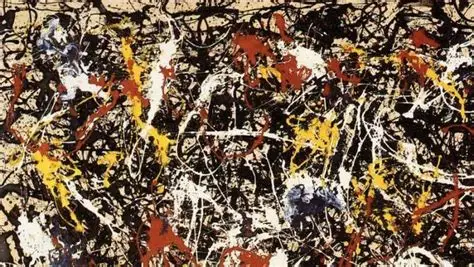
Pollock’s famous paintings can appear chaotic at first glance. Lines of black, white, silver, brown, yellow, and other colors cross the surface without recognizable figures or conventional perspective. Yet these works were not simply random explosions of paint. They emerged from years of artistic development and from Pollock’s sustained investigation of drawing, mythology, psychology, Indigenous art,
European modernism, Mexican mural painting, and the physical properties of paint itself.
Pollock spent much of his childhood and adolescence in the American West before moving to New York in 1930. There he studied with Thomas Hart Benton at the Art Students League. Benton was known for figurative murals depicting American life, and his style appears very different from Pollock’s mature abstraction. Nevertheless, the older artist’s emphasis on sweeping rhythms, large compositions, and energetic movement had a lasting influence.
Mexican muralists were equally important. Pollock encountered the monumental work and experimental techniques associated with artists such as José Clemente Orozco, Diego Rivera, and David Alfaro
Siqueiros. Their willingness to work on enormous surfaces and use unconventional materials demonstrated that painting did not need to remain confined to the traditional easel.
During the 1930s and early 1940s, Pollock struggled to establish a mature style. His paintings contained distorted figures, animals, masks, mythological imagery, and mysterious symbols. Pablo Picasso and Surrealism provided important points of reference, particularly the idea that art could engage unconscious thought rather than simply reproduce visible reality.
Pollock also became interested in Jungian psychology during a period of personal treatment. Archetypes, mythology, and the possibility of images emerging from unconscious processes entered his developing artistic vocabulary. Early works often contain recognizable forms, but these forms increasingly become entangled within networks of lines and gestures.
A major turning point came after Pollock and his wife, the painter Lee Krasner, moved from New York City to Springs on Long Island in 1945. The property included a barn that Pollock converted into a studio. The larger working space allowed him to abandon the conventional relationship between painter, easel, and upright canvas.
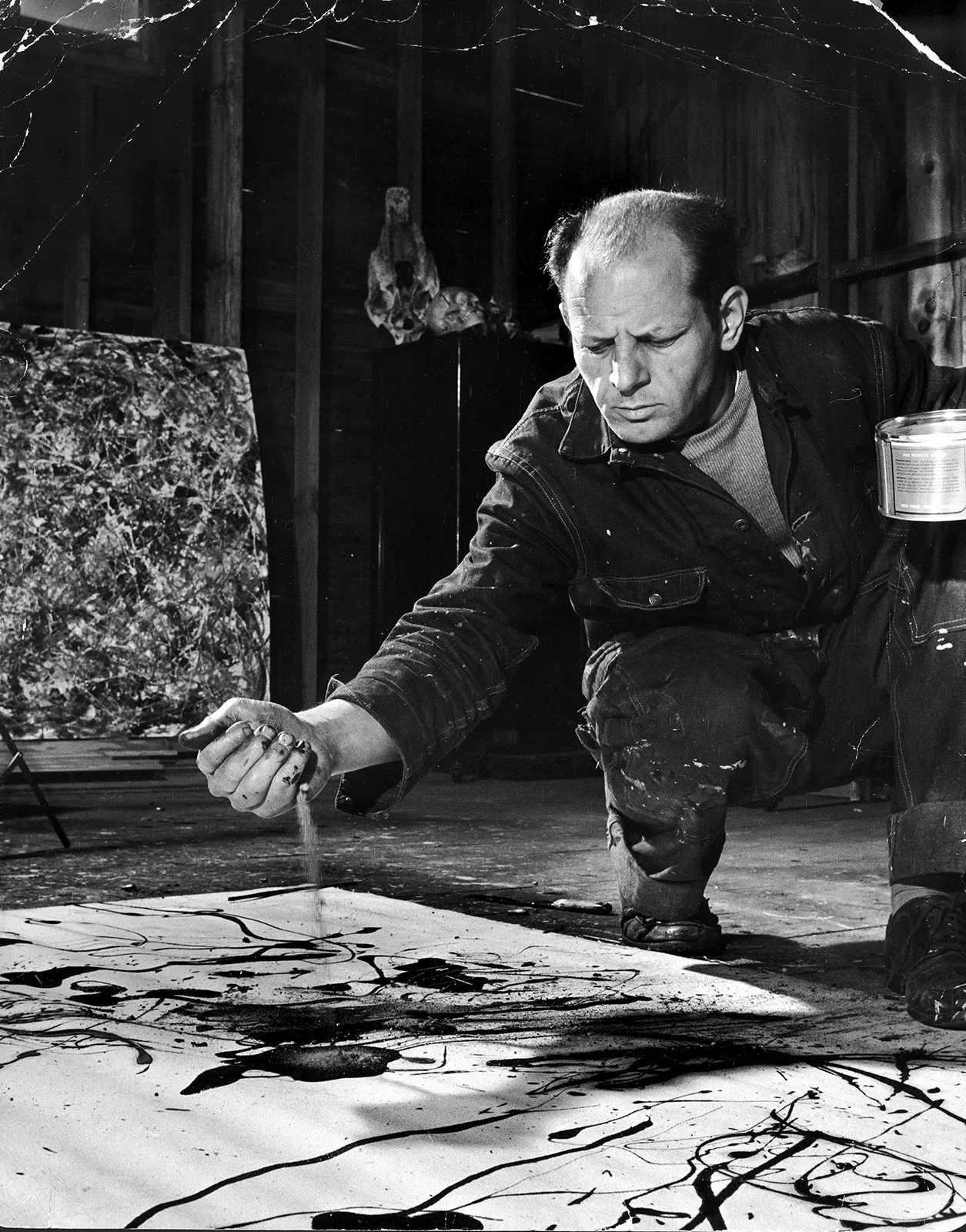
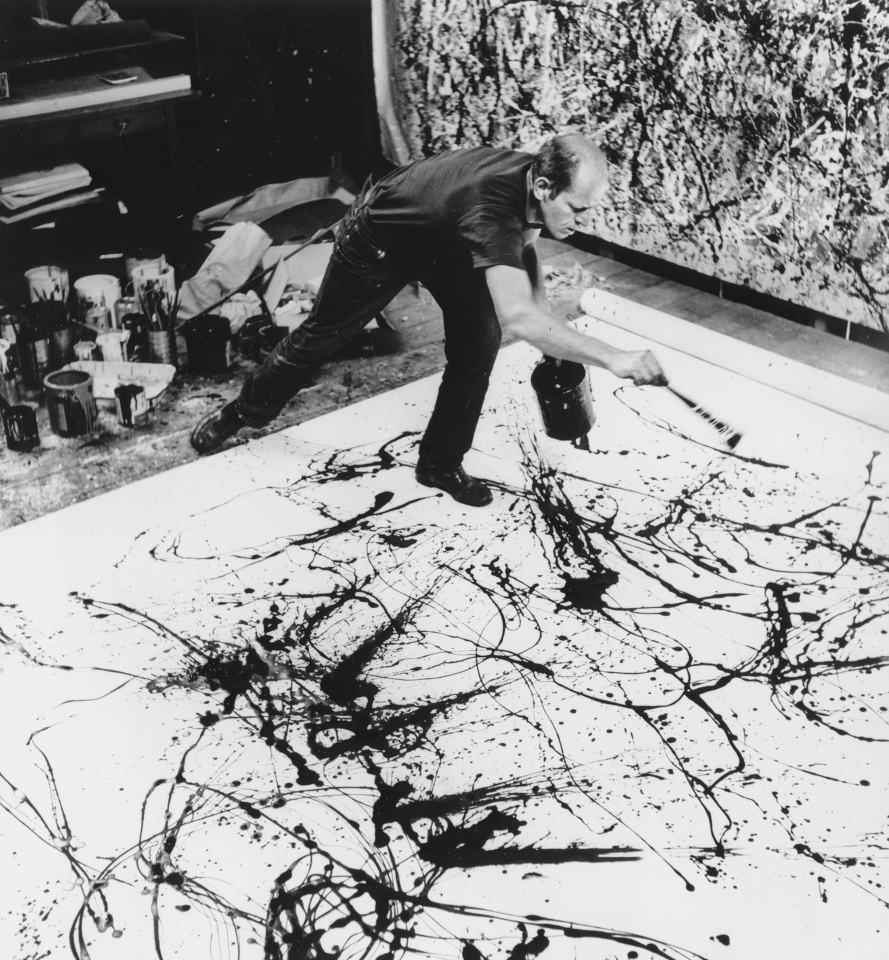
Instead of placing the canvas vertically, Pollock spread unstretched material directly across the floor. This simple change radically altered what his body could do. He could approach the painting from every direction, walk around it, reach across it, and physically enter the space surrounding the image while working.
Pollock began using sticks, hardened brushes, turkey basters, and other tools to drip, pour, flick, and direct liquid paint. Commercial enamel paints were particularly useful because their fluid consistency allowed long continuous lines to move across the surface.
Gravity became a collaborator. Paint could fall through the air rather than being applied only through direct contact between brush and canvas. The distance between Pollock’s hand and the surface became another artistic variable.
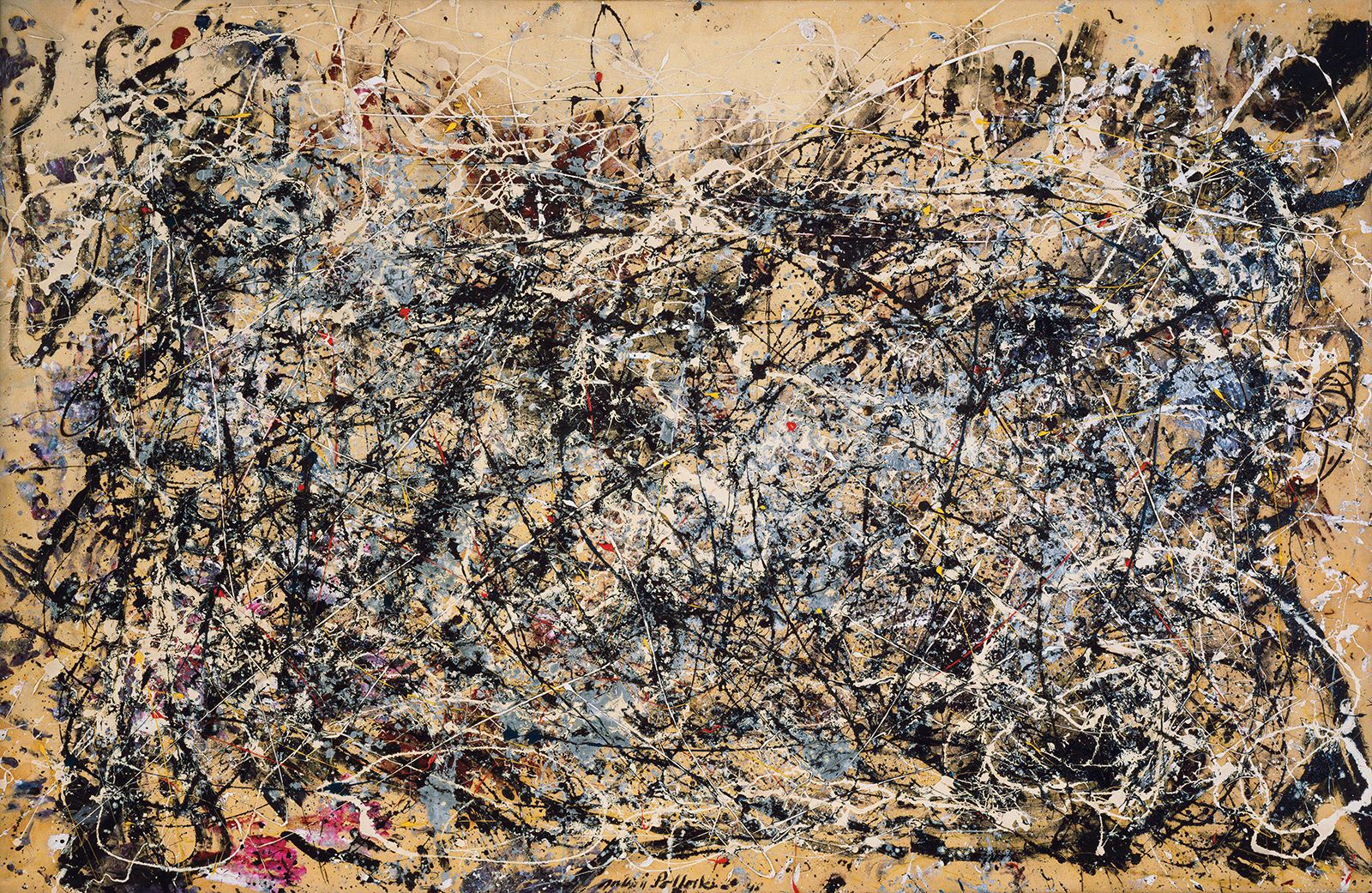
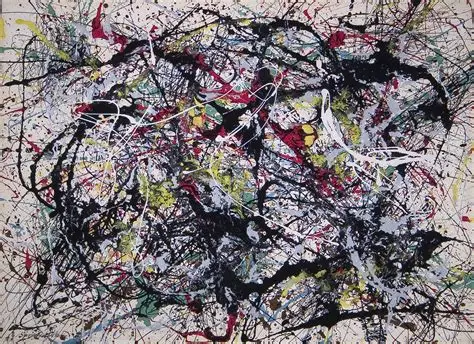
This process produced the paintings now most closely associated with his name. Works such as Autumn Rhythm (Number 30), One: Number 31, 1950, and Number 1A, 1948 contain dense networks of intersecting lines that appear to continue beyond the edges of the canvas.
There is often no traditional center. The viewer’s attention moves across the entire surface rather than toward one dominant figure or object. Art historians later used the term “all-over composition” to describe this structure.
The absence of a conventional focal point was revolutionary. Western painting had traditionally organized images hierarchically. A central figure, landscape feature, or narrative event usually directed attention. Pollock instead created fields in which every part of the canvas participates in the total visual experience.
The physical process behind these paintings became famous partly through photographs and films showing Pollock at work. Photographer Hans Namuth documented him moving around canvases, pouring paint with remarkable concentration. These images helped create the popular idea of Pollock as an instinctive artist attacking the canvas through spontaneous gesture.
The reality was more complicated. Film and close examination of the paintings reveal considerable control. Pollock adjusted speed, distance, viscosity, direction, and movement. Different kinds of marks required different physical actions. Thin lines, heavy pools, scattered droplets, and broad areas of paint were not produced in the same way.
Accident remained important, but accident operated within a structured process. Pollock could not predict the exact path of every drop, yet he could respond continuously to what appeared. Painting became a conversation between intention and material behavior.
This balance helps explain why simply throwing paint onto a surface does not automatically produce a Pollock. His achievement was not the invention of dripping itself. Artists had used poured and splattered paint before him. Pollock developed these techniques into a sustained compositional language capable of organizing extremely complex surfaces.
The term “Action Painting,” later strongly associated with Pollock, emphasized this relationship between artwork and physical activity. The canvas was no longer simply a surface on which an image appeared. It became the record of actions performed over time.
A line therefore contains evidence of movement. It records where the hand traveled, how quickly the body moved, and how paint responded to gravity. The finished work preserves a history of its own creation.
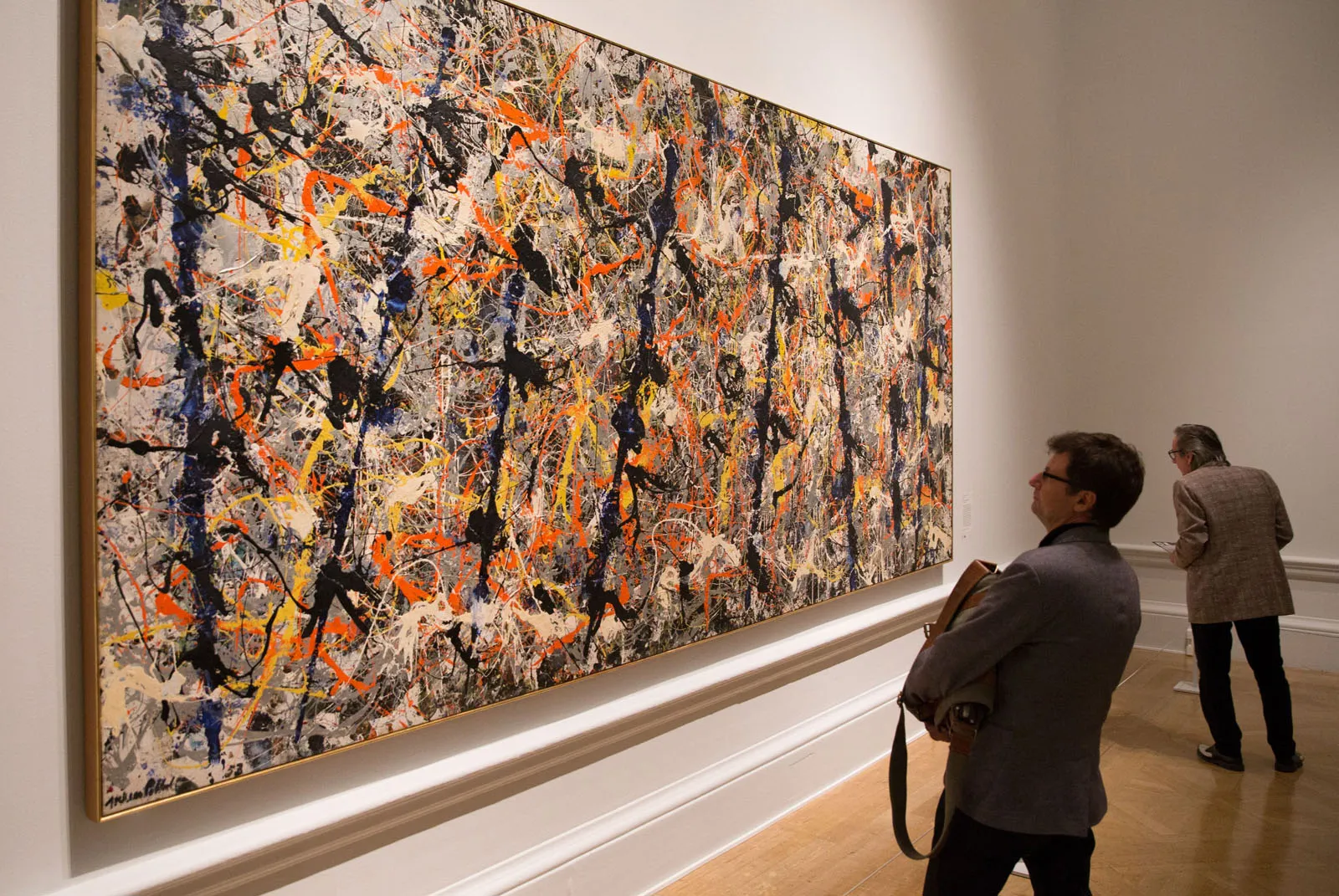
Pollock’s paintings also transformed scale. Many of his mature works are enormous. Their dimensions prevent viewers from taking in the entire image comfortably from close range. The painting extends beyond ordinary peripheral vision and begins to function almost like an environment.
This scale contributed to the international impact of Abstract Expressionism. American painters were creating works whose physical presence competed with monumental European historical painting while abandoning historical narrative entirely.
Pollock became increasingly famous during the late 1940s and early 1950s. A 1949 Life magazine article famously asked whether he was the greatest living painter in the United States. The question was provocative, but it helped transform him from an avant-garde figure into a national cultural phenomenon.
His public image became intertwined with postwar ideas about American individualism. Pollock was presented as physically direct, independent, rebellious, and distinctly different from the intellectual traditions associated with European art.
This mythology was useful but incomplete. Pollock’s work depended heavily on European modernism, Indigenous artistic traditions, Mexican muralism, psychology, and the broader international history of abstraction. His achievement came from transforming these influences rather than working outside them.
His relationship with Lee Krasner was especially important. Krasner was herself a major Abstract Expressionist painter with extensive artistic training and a sophisticated understanding of modern art. She supported Pollock’s career, introduced him to important networks, managed practical aspects of their life, and continued protecting and organizing his legacy after his death.
For decades, Krasner’s own achievements were overshadowed by Pollock’s fame. Contemporary scholarship has increasingly restored her independent importance and challenged the old narrative in which she appeared primarily as the wife of a male genius.
Pollock’s most celebrated drip period was relatively short. Around 1951, he began moving away from the dense colored networks that had brought him international recognition. His so-called black pourings used dark enamel paint on unprimed canvas and sometimes allowed recognizable figures to reappear.
This shift disappointed some collectors and critics who expected him to continue producing the style that had become commercially and culturally successful. Pollock, however, resisted turning his breakthrough into a formula.
The black paintings reveal how persistent the human figure remained within his imagination. Heads, bodies, eyes, and totemic forms appear within flowing dark lines. Figuration and abstraction had never been completely separate in his work.
His later paintings continued searching for new possibilities, but his personal life became increasingly unstable. Alcohol dependence, which had affected him for many years, worsened. Periods of intense productivity became more difficult to sustain.
Pollock died in a car crash on Long Island in 1956 at the age of forty-four. His passenger Edith Metzger also died, while Ruth Kligman survived. The early death contributed to the mythology surrounding Pollock, but focusing excessively on tragedy risks obscuring the seriousness of his artistic achievement.
His influence after 1956 was enormous. Some younger artists adopted aspects of gestural abstraction, while others reacted directly against it. Minimalism, Pop Art, Conceptual Art, and other movements partly defined themselves through opposition to the heroic mythology associated with Abstract Expressionism.
Even rejection demonstrated Pollock’s importance. Artists had to respond to the territory he had opened.
His methods also anticipated performance art. The artist’s movement, duration of work, interaction with materials, and physical environment became inseparable from the final object. The painting could be understood as evidence left behind by an action.
Contemporary artists working with pouring, staining, gravity, bodily movement, chance, and unconventional tools continue to operate within possibilities Pollock helped make central to modern painting.
His work also changed the viewer’s relationship with abstraction. A Pollock painting does not require the spectator to identify an object or decode a conventional story. Meaning can emerge from scale, rhythm, density, movement, repetition, color, and physical response.
Some viewers experience energy. Others see landscape-like depth, chaos, order, music, networks, or traces of movement. Pollock did not provide one fixed interpretation.
This openness explains why his paintings remain powerful despite becoming icons of art history. Reproductions cannot fully communicate their physical scale. Standing before a major Pollock is very different from seeing the image in a book or on a screen.
Lines overlap at different depths. Thick paint sits physically above thin stains. Metallic enamel reflects light differently as the viewer moves. Small areas of bare canvas remain visible beneath dense networks.
The painting changes with distance. From across a gallery, the entire surface may appear unified. Up close, it breaks into hundreds of individual events.
At ArtExpoWorld, we consider Jackson Pollock one of the artists who fundamentally changed the meaning of artistic technique. Before Pollock, viewers often imagined the brush as a tool used to describe something: a face, tree, building, cloud, or object. In his mature work, the movement of paint itself became the subject.
A line no longer needed to outline a figure. It could record an action.
A drop did not need to represent anything. Its weight, direction, speed, and relationship with surrounding marks were enough.
Pollock therefore helped move painting away from the question ‘What does this picture show?’ toward another question: ‘What happened on this surface?’
That shift became one of the foundations of postwar contemporary art.
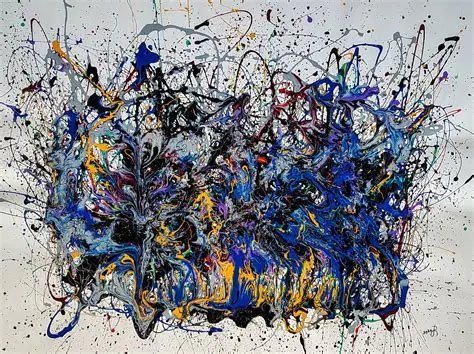
Jackson Pollock’s legacy lies not in teaching generations of artists to throw paint. It lies in demonstrating that the process of making an artwork can carry as much meaning as the image produced.
He transformed canvas from a window onto another world into a physical arena where movement, material, chance, and decision could become visible.
More than seventy years after his greatest drip paintings were created, their networks still feel remarkably alive because every line contains evidence of an event. The artist has disappeared, the movement has ended, and the paint has dried — but the action remains permanently suspended on the surface.
At ArtExpoWorld, we see Jackson Pollock as a defining figure of modern abstraction whose breakthrough permanently expanded the possibilities of painting and changed the relationship between artist, material, canvas, and viewer.