







How New Art Buyers Are Transforming Gallery Sales
The upper end of the art market may be experiencing slower growth, but new buyers continue to enter at almost every price level.
In 2024, 44% of gallery clients were new to the dealers from whom they purchased.
The share of sales made to first-time buyers reached 38%, rising by five percentage points from the previous year.
These figures suggest that demand has not disappeared.
It has changed.
New collectors are discovering art through Instagram, online marketplaces, auction platforms, artist studios, prints, editions and smaller galleries offering more accessible price points.
For galleries, reaching these buyers is only the first challenge.
The more difficult task is converting a single online purchase into a long-term relationship with art.
The Lower and Middle Market Are Attracting New Buyers
Public attention usually focuses on paintings selling for tens of millions of dollars.
However, activity at lower price levels can reveal more about the future collector base.
In 2024, auction sales of works priced below USD 5,000 increased by 7%.
Dealers with annual turnover below USD 250,000 reported a 17% increase in sales.

About half of the transactions made by dealers in this smaller category involved clients buying from them for the first time.
Lower prices reduce one of the main barriers facing new collectors.
A person may be willing to spend USD 1,000 or USD 3,000 on a first artwork while feeling completely excluded from a market associated with six-figure paintings.
Smaller galleries and editions can therefore become entry points into the wider art world.
Liesl Fichardt Sees an Opportunity in Corrected Prices
London-based lawyer and collector Liesl Fichardt has observed that falling prices for some ultra-contemporary artists may be attracting buyers with more modest budgets.
During the most speculative years, demand pushed the prices of young artists upward at extraordinary speed.
Some works were purchased and resold before the artists had time to develop stable careers.
As that market cooled, galleries began reconsidering their price structures.

Smaller and younger galleries, as well as some established businesses, introduced programs featuring emerging artists at more accessible levels.
This correction can benefit serious new collectors.
It creates an opportunity to evaluate artists without the pressure generated by waiting lists and rapidly rising prices.
The collector must still distinguish between a genuine reassessment and an artist whose market has collapsed because earlier demand had little connection with artistic quality.
New Collectors Are Also Entering at the Highest Levels
The new-buyer phenomenon is not limited to affordable art.
Art advisor Nilani Trent has noted that recent wealth creation and greater access to investment knowledge have also brought new high-net-worth buyers into the market.
Research found that 26% of surveyed high-net-worth collectors had begun their collections during the previous five years.
That was higher than the proportion recorded in earlier surveys.

New buyers also represented approximately 30% of the ultra-high-net-worth segment with wealth above USD 50 million.
Many had relatively small collections but significant purchasing capacity.
This creates both opportunity and risk for galleries.
A wealthy first-time buyer may quickly acquire major works without having developed knowledge about quality, condition or provenance.
Responsible galleries should educate these clients rather than simply maximizing the first sale.
Online Viewing Rooms Opened the Market
Online viewing rooms, commonly known as OVRs, became essential during the pandemic.
In March 2020, Art Basel in Hong Kong offered approximately 2,000 works through online viewing rooms with an estimated combined value of USD 270 million.
The systems allowed collectors to browse remotely while galleries were unable to meet clients at physical fairs.
Even before the pandemic, expensive artworks were already being sold online.

In 2019, Gagosian reportedly sold a painting by Albert Oehlen for USD 6 million only three hours after it appeared online.
The buyer had not previously acquired an Oehlen work from the gallery and purchased the painting without seeing it in person.
This demonstrated that digital presentation could support very high-value transactions when confidence in the artist and gallery already existed.
Why Online Viewing Rooms Lost Momentum
The excitement surrounding OVRs did not continue at the same intensity after physical fairs and galleries reopened.
Collectors became tired of viewing art exclusively through screens.
Kelly Woods, partner at Marianne Boesky Gallery in New York, has argued that online sales can become highly transactional.
A platform can produce a sale but may fail to create the deeper relationship required to develop a committed collector.
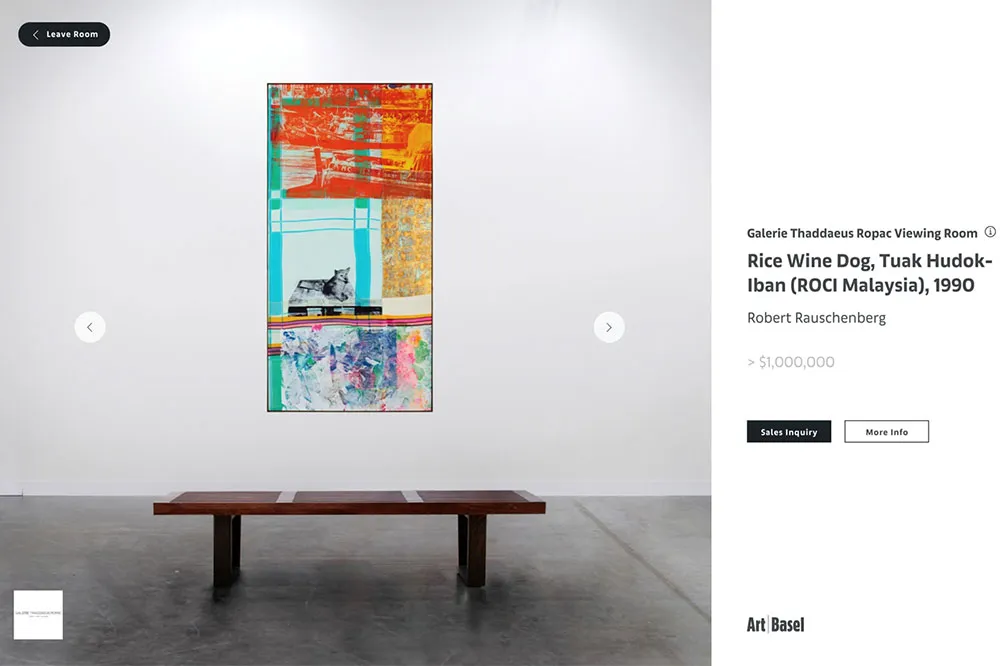
Scale, texture, surface and physical presence are difficult to judge online.
A buyer may also miss the conversations that place the artwork within the artist’s wider practice.
Woods emphasizes the importance of personal contact.
Meeting collectors, visiting cities, arranging dinners and traveling together can create trust that a digital checkout page cannot reproduce.
New Buyers Need Help Filtering the Market
The internet has made more art visible than ever.
It has also created more noise.
Thousands of galleries, artists, fairs and platforms compete for attention.
Social media can make an artist appear internationally successful before the work has received serious critical or institutional examination.
New collectors often need a trusted person to help interpret this information.
A gallerist can explain:
how the artist’s work has developed;
why one series is more important than another;
how prices are structured;
which museums or curators have engaged with the work;
what documentation should accompany the purchase;
how the artwork should be maintained.
This educational role is one of the strongest reasons galleries remain relevant despite the growth of direct and online sales.
Prints and Multiples Offer an Accessible Entry Point
Online platforms are particularly effective for editions.
Prints, photographs and small sculptures are easier to present through standardized information.
Buyers can compare size, edition number, price and shipping terms.
Avant Arte has become one of the most visible platforms in this market.
Its sales of print and sculpture editions reportedly reached USD 23 million, representing a 53% increase from the previous year.
About one-third of its clients had been collecting for less than two years.
Platforms such as Avant Arte and Heni appeal to new buyers because prices are usually visible, transactions are immediate and works can be acquired without bidding at auction.
Heni has produced editions connected with artists including Damien Hirst, as well as NFTs and other collectible projects.
Accessible Does Not Mean Risk-Free
Edition platforms reduce some barriers but create others.
The buying process may be impersonal.
The platform may be designed to sell newly released objects without offering long-term support if the collector later wants to resell, lend or research the work.
Collectors should examine edition sizes carefully.
A low-priced print issued in very large numbers may have limited rarity.
Buyers should also check whether the artist has approved the edition and whether it was produced by a respected publisher.
Instant availability can encourage impulsive purchases.
The collector should apply the same standards used for a unique artwork.
Is the work important within the artist’s practice?
Would you still want it without the famous name?
Do you understand the edition and resale limitations?
Auction Houses Have Adapted Faster Than Many Galleries
Auction houses have moved a large part of their business online.
In 2024, approximately 81% of bids at Christie’s were placed digitally.
In Asia, 44% of the auction house’s buyers or bidders were millennials or younger.
Phillips also attracted new clients, with 31% of buyers in 2024 purchasing from the company for the first time.
Auction systems are well suited to digital transactions.
Condition reports, estimates, provenance and sale dates follow standardized formats.
Bidders can participate from different countries without attending the room.
However, online bidding can create emotional pressure.
Collectors should inspect the work whenever possible and review condition and provenance before the auction begins.
The final cost must include the buyer’s premium, taxes, shipping and possible conservation.
Price Transparency Matters to New Collectors
Many galleries traditionally avoided displaying prices publicly.
A visitor had to request a price list or ask a staff member.
For experienced collectors, this was a familiar part of gallery culture.
For newcomers, it could feel exclusionary.

Jeremy Epstein, co-founder of the London gallery Edel Assanti, has identified price transparency as an important issue for new audiences.
Internet-native collectors are accustomed to researching products and making comparisons before beginning a conversation.
A gallery that provides artist information but hides every price may lose buyers who assume the work is unaffordable or who feel uncomfortable asking.
Since the pandemic, more galleries and artists have become willing to display prices online.
Transparency does not remove the need for personal selling.
It creates a clearer starting point for the relationship.
A Digital Contact Should Become a Human Relationship
Online platforms are extremely effective at discovery.
A collector in one country can encounter a young gallery on another continent within seconds.
The challenge is what happens next.

A gallery can use the digital connection to offer:
a video call about the artist;
additional photographs;
installation views;
a studio visit;
invitations to exhibitions;
meetings at an art fair;
introductions to curators and other collectors.
The objective should not be to move every buyer offline.
It should be to add knowledge and trust to the transaction.
A person who purchases one print online may later buy a unique work, join a museum group or support an artist’s exhibition.
That development rarely happens through automated marketing alone.
New Buyers Need Education, Not Intimidation
The art market often presents itself through codes that are difficult for outsiders to understand.
Prices may be hidden. Availability may be unclear. Buyers may be told that a work is reserved without knowing how waiting lists operate.
This mystery can make the market appear prestigious, but it can also drive away serious newcomers.
Galleries should explain their processes.
A first-time buyer should understand why certain works are offered to institutions or established clients first.
They should know what documents they will receive and whether payment plans are available.
Education builds confidence.
Intimidation may create one profitable sale, but it rarely creates a loyal collector.
Not Every New Buyer Will Become a Collector
A customer and a collector are not always the same thing.
Some people purchase a single artwork as decoration, a gift or a status symbol and never return.
Others gradually develop deeper engagement.
They visit exhibitions, follow artists, read, lend works and build relationships with institutions.
Galleries cannot force this transition.
They can create the conditions for it by treating small first purchases seriously.
A person buying a USD 500 edition today may become an important patron later.
Even when they do not, they can still become part of the audience supporting artists and galleries.
Editorial Note
ArtExpoWorld believes the new wave of buyers is healthy for the art market, but only when accessibility is matched by education.
Visible prices, online platforms and lower-cost editions can help people make a first purchase without feeling excluded.
However, speed and convenience can also turn art into another form of online shopping.
A serious art market cannot survive through transactions alone.
Galleries remain important because they provide context, protect artists’ careers and build communities around art.
The future is not a choice between online sales and human relationships.
The strongest galleries will use digital tools to open the door and personal knowledge to give collectors a reason to stay.