









Gustave Caillebotte was a French painter, collector, patron, organizer, gardener, and yachtsman whose distinctive images of modern Paris expanded the visual language of Impressionism. Born into a wealthy Parisian family in 1848, he approached contemporary life with an unusual combination of realism, geometric structure, photographic cropping, and experimental perspective. His paintings of workers, boulevards, interiors, balconies, rivers, gardens, and fashionable citizens reveal a city being rapidly transformed by architecture, industry, wealth, and modern social behavior.
Caillebotte initially studied law before committing himself seriously to painting. In the early 1870s, he trained in the studio of Léon Bonnat and was accepted at the École des Beaux-Arts. His academic education provided strong technical foundations, but his interests quickly moved toward the experimental painters who were challenging the official Salon system.
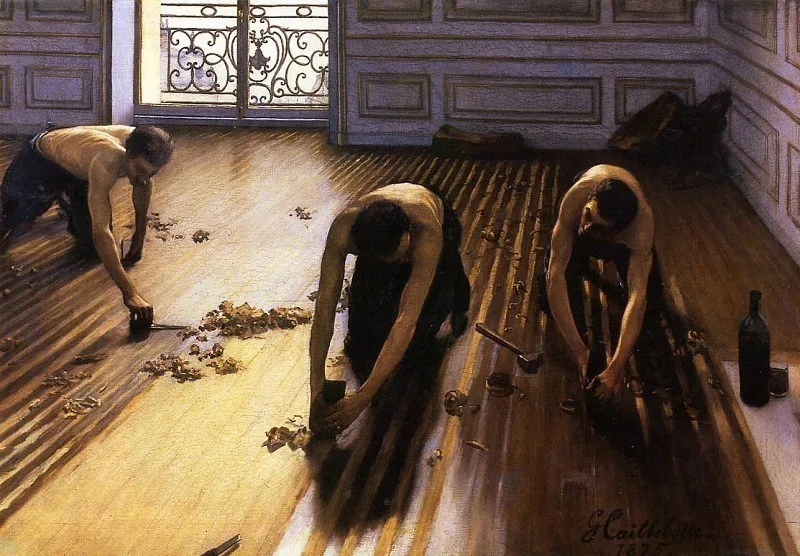
In 1875, his submission to the Salon was rejected. The painting is generally identified as The Floor Scrapers, one of his most famous works.
Rather than abandoning the subject, Caillebotte joined the Impressionist circle and exhibited with them. The Floor Scrapers became one of the sensations of the second Impressionist exhibition in 1876.
The work depicts shirtless laborers scraping and finishing a wooden floor. Working-class men had appeared in European painting before, but rarely inside a refined bourgeois apartment and on such a monumental scale.
Caillebotte’s approach is neither sentimental nor heroic. The men are absorbed in physical labor, their bodies bent according to the demands of the task.
The extraordinary perspective draws the viewer into the room. Floorboards extend sharply toward the background, while the workers repeat the direction of the architecture.
This relationship between body and space became one of Caillebotte’s defining concerns.
He was fascinated by modern Paris, which had been transformed through the large-scale urban projects associated with Baron Haussmann. New boulevards, apartment buildings, bridges, railway stations, sidewalks, and public spaces created a city designed for circulation.
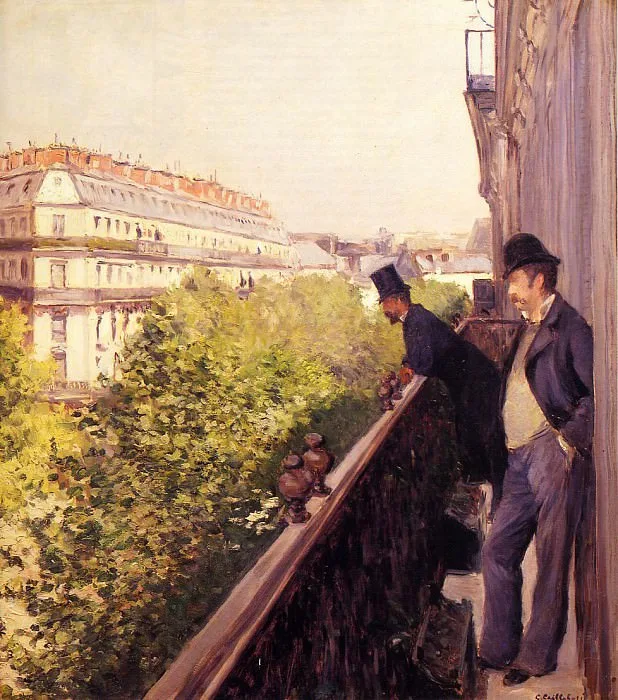
Caillebotte painted this new environment from unusual viewpoints: balconies, elevated windows, street corners, bridges, and sharply angled sidewalks.
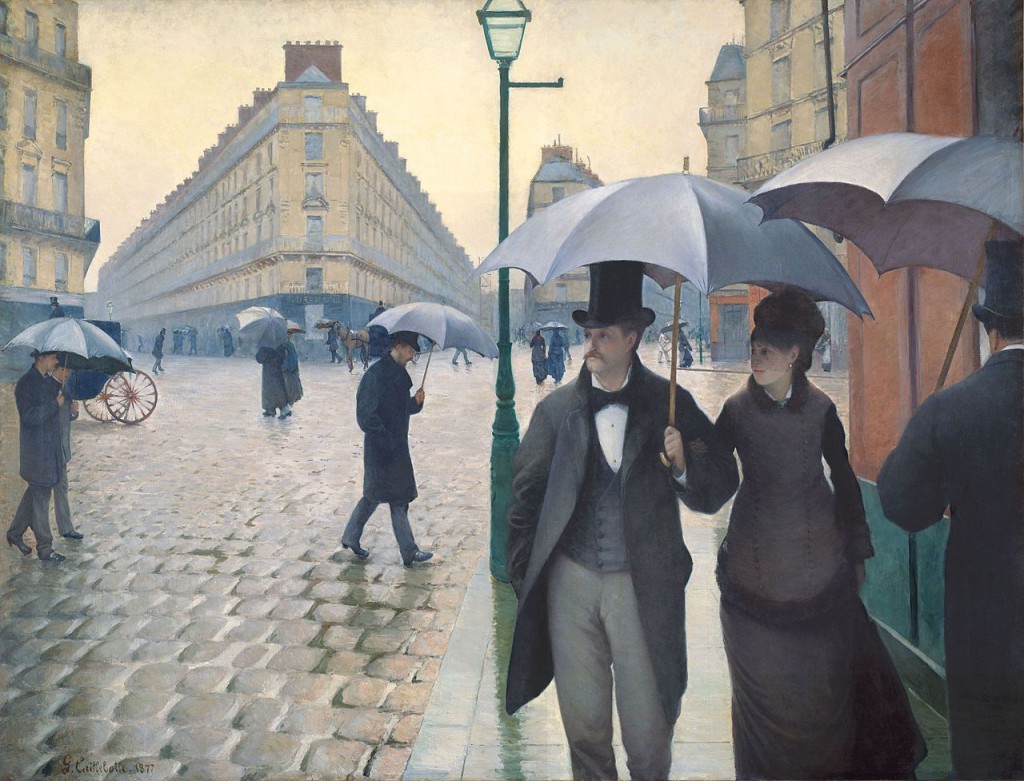
His most famous city painting, Paris Street; Rainy Day, presents fashionable pedestrians crossing a broad intersection beneath umbrellas.
The composition is immediately striking because the figures are cropped and distributed in ways that feel unexpectedly modern. A large couple dominates the foreground while other pedestrians recede through the city.
The street appears expansive, yet the emotional relationships remain distant. People pass one another without interacting. Modern architecture creates physical order but does not guarantee social connection.
This quality separates Caillebotte from many other Impressionists. While Monet often concentrated on atmosphere and changing light, Caillebotte frequently emphasized structure, geometry, perspective, and the psychology of modern urban space.
The National Gallery of Art notes that his paintings used skewed viewpoints and contemporary subjects to capture the visual drama of a city undergoing radical transformation.
Photography was still relatively young during Caillebotte’s career, but several of his compositions anticipate photographic ways of seeing. Figures are unexpectedly cropped, objects enter from the edge, and viewpoints may appear dramatically high or low.
This does not mean he simply copied photographs. His paintings demonstrate how modern technologies and urban experience were changing visual expectations more broadly.
In The Pont de l’Europe, a man looks through the iron structure of a bridge while pedestrians occupy different distances within the scene.
The bridge itself becomes almost as important as the people. Industrial engineering, social class, movement, and modern city life are compressed into one image.
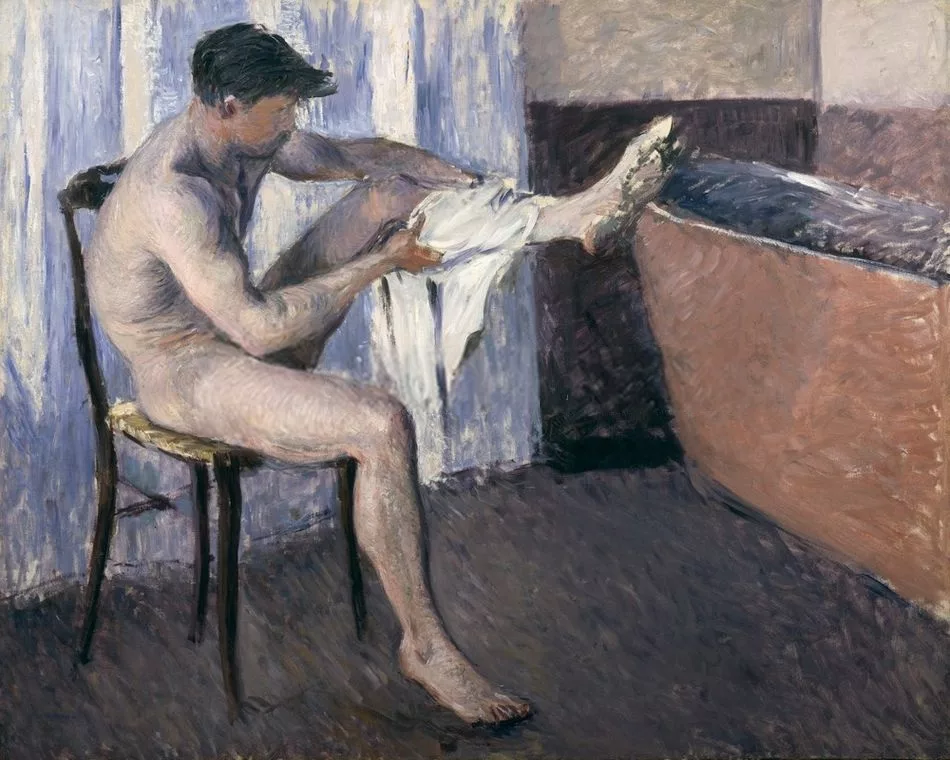
Caillebotte also painted numerous domestic interiors. Men read newspapers, look through windows, sit at tables, or occupy rooms that communicate wealth but also emotional isolation.
These interiors reveal his own bourgeois environment. Musée d’Orsay notes that his earliest major paintings frequently drew from his family and the houses in which they lived.
His younger brothers served as models, and family residences provided carefully observed settings.
Yet these paintings are rarely simple celebrations of privilege. Their scale, distance, and silence often produce uncertainty.
A man standing at a window may possess financial security while appearing psychologically separated from the outside world.
Caillebotte’s own financial independence dramatically affected his artistic career. Because he inherited substantial wealth, he did not need to rely heavily on the sale of his paintings.
This allowed him to support artists whose work he admired. He purchased paintings by Monet, Renoir, Degas, Cézanne, Pissarro, Morisot, and Sisley, among others.
He also helped finance and organize Impressionist exhibitions. His importance to the movement was therefore both artistic and institutional.
Caillebotte attempted to maintain cooperation among artists whose personalities and artistic positions could be difficult to reconcile. He understood that a movement depended not only on painting but on exhibition logistics, money, organization, and access to audiences.
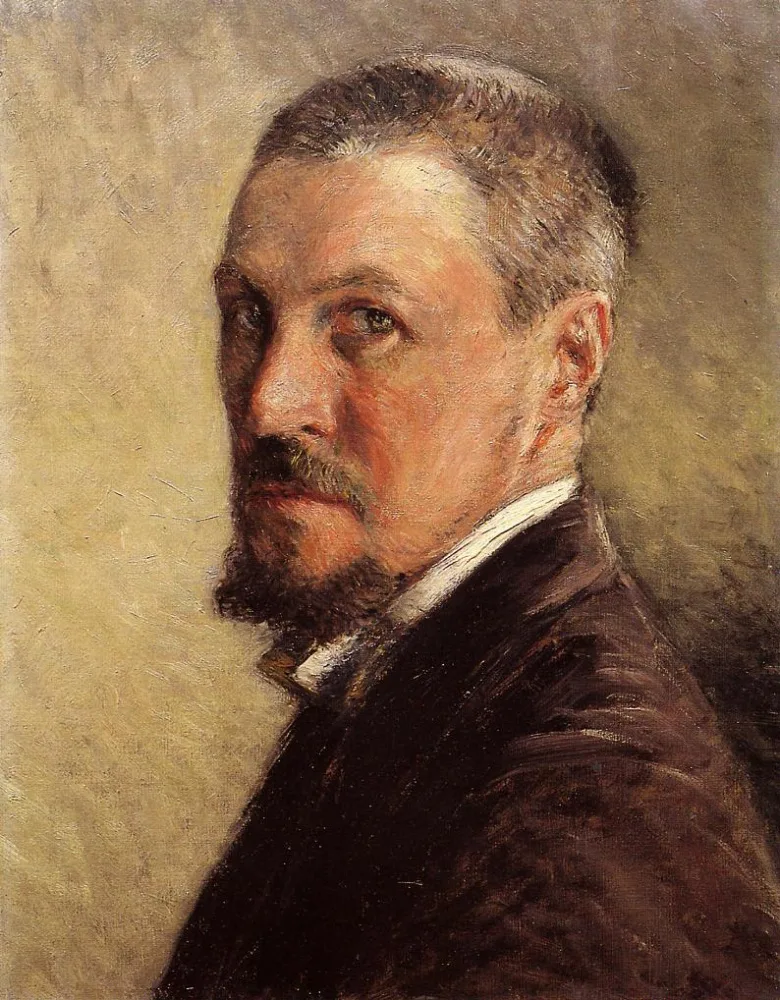
His self-portrait at the easel from 1879 reveals this dual identity. He depicts himself inside an environment containing works from his own Impressionist collection, including Renoir’s Bal du moulin de la Galette. Musée d’Orsay has described the work as a kind of manifesto of his identity as both painter and collector.
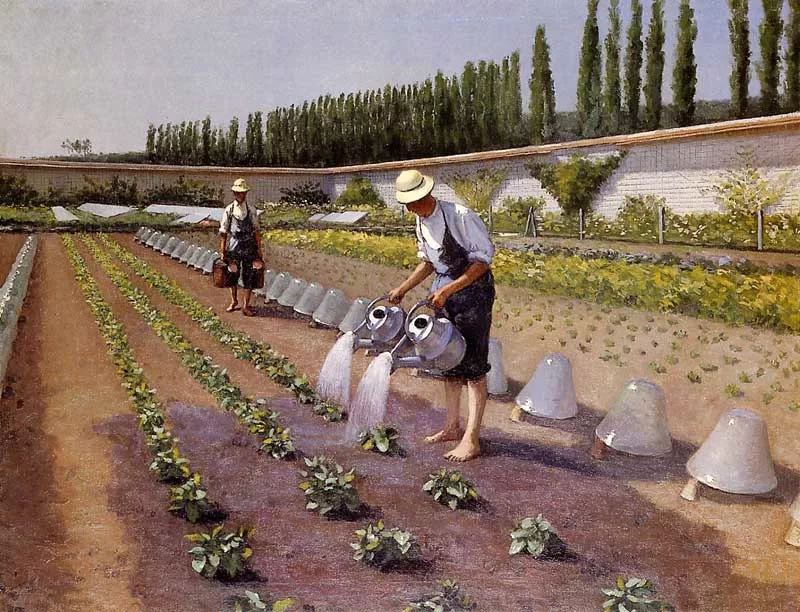
Caillebotte’s interests eventually expanded away from central Paris.
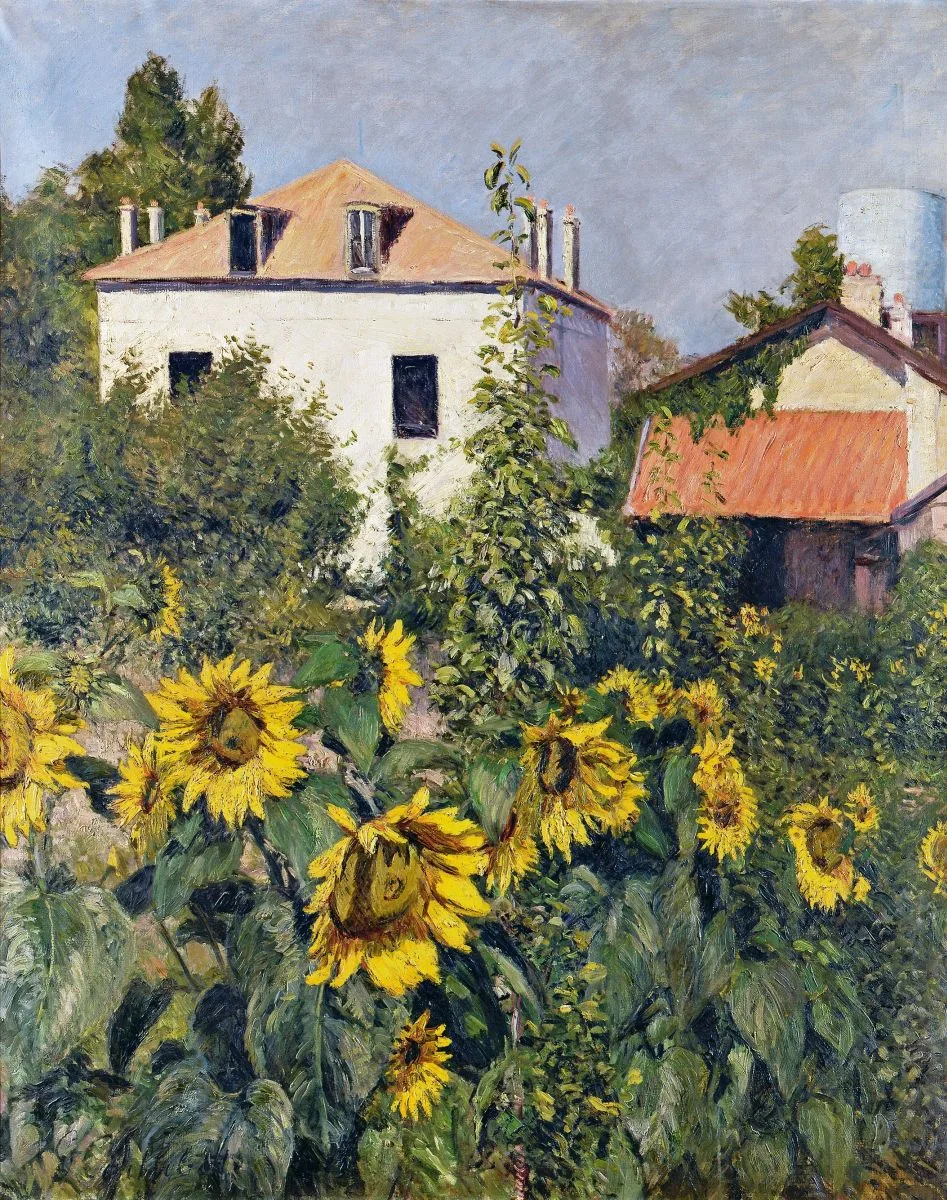
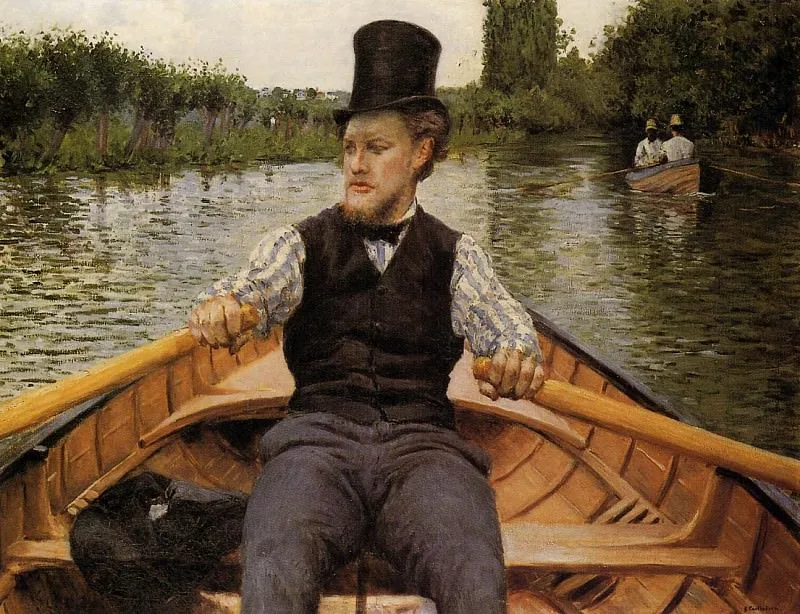
In the early 1880s, he and his brother Martial purchased property at Petit-Gennevilliers on the Seine. Gardening, boating, and yacht design became major parts of his life.
River scenes, sailing boats, gardens, flowers, and suburban landscapes increasingly entered his paintings.
His late style became looser and brighter. The disciplined geometry of Parisian streets did not disappear completely, but direct engagement with outdoor light became more prominent.
Caillebotte was a serious yachtsman and designed racing boats. His final large-format painting, Regatta at Argenteuil, connects painting with this passion. Musée d’Orsay notes that the work presents him at the helm of a racing boat he had designed and built.
This combination of painter, collector, engineer, gardener, and sailor makes Caillebotte unusually difficult to reduce to one artistic identity.
His most important contribution to art history may have occurred partly after his death.
In 1879, while still relatively young, Caillebotte wrote a will leaving his collection of Impressionist art to the French state. At the time, many of these artists remained controversial.
The government did not immediately accept the entire gift. Eventually, thirty-eight paintings from the bequest entered the national collection, creating one of the foundations of what later became France’s extraordinary public holdings of Impressionism.
Caillebotte died in 1894 at only forty-five. Because he rarely needed to sell his own paintings, many remained with his family rather than entering public museums.
This contributed to the strange history of his reputation. He was enormously important within the Impressionist circle but became less internationally famous than Monet, Renoir, Degas, or Pissarro.
Major exhibitions and scholarship gradually restored his position as one of the movement’s most distinctive painters.
At ArtExpoWorld, we consider Gustave Caillebotte essential because he showed another side of Impressionism.
He was interested in modern light, but also modern architecture. He painted leisure, but also labor. He observed wealthy citizens, but also workers. He embraced contemporary life while preserving extraordinary structural discipline.
His paintings remain striking because their perspectives still feel fresh. A street opens unexpectedly. A railing cuts through space. A figure disappears beyond the edge of the frame.
Gustave Caillebotte understood that modernity changed not only what artists painted but how people physically experienced space. Through radical viewpoints and quiet psychological observation, he transformed nineteenth-century Paris into images that continue to feel surprisingly contemporary.