









Caspar David Friedrich was the defining landscape painter of German Romanticism and one of the most influential artists to transform nature into a space for psychological, philosophical, and spiritual experience. Born in Greifswald on the Baltic coast in 1774, Friedrich created landscapes of mountains, seas, ruined churches, forests, moonlight, fog, snow, graves, ships, and solitary human figures. His paintings do not simply describe geography. They invite viewers to confront distance, mortality, faith, uncertainty, and humanity’s small place within an immense natural world. The Alte Nationalgalerie describes him as the most important painter of German Romanticism.
Friedrich grew up near the Baltic Sea in a strict Protestant household. Experiences of death deeply affected his childhood, including the loss of family members.
These events have often been used to interpret the melancholy atmosphere of his paintings, but Friedrich’s art cannot be reduced to biography.
His landscapes emerged from a broader Romantic culture interested in nature, religion, emotion, philosophy, poetry, and the limits of rational knowledge.
Friedrich studied at the Copenhagen Academy of Fine Arts, one of northern Europe’s important artistic centers. The academy emphasized precision in drawing and close observation of nature.
In 1798, at the age of twenty-four, he settled in Dresden, where he remained for most of his life.
Dresden offered contact with artists, writers, intellectuals, collections, and the developing culture of German Romanticism.
Friedrich worked slowly and carefully.
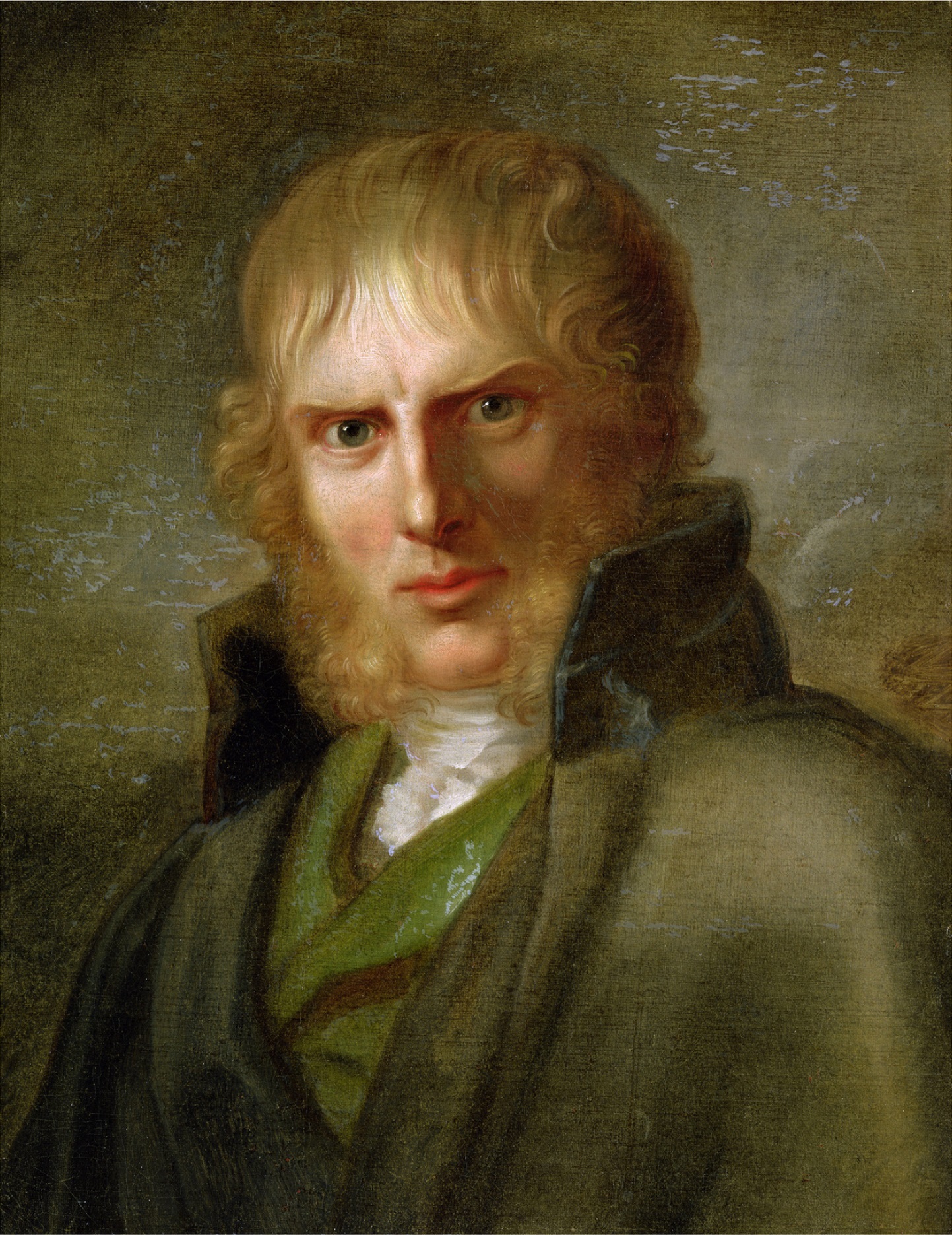
He made detailed studies of trees, rocks, mountains, architecture, clouds, coastlines, ships, and figures outdoors, but his finished paintings were usually constructed in the studio.
He combined elements observed in different places and at different times to create landscapes that feel believable without necessarily representing one exact location.
This distinction is essential.
Friedrich was not painting topographical views. He was building emotional and symbolic environments.
A mountain may come from one sketch, a tree from another, and a figure from a separate study.
The final composition exists as an invented reality created from observed fragments.
One of Friedrich’s most important innovations was the use of the Rückenfigur, a figure shown from behind looking into the landscape.
The viewer does not confront the figure’s face. Instead, we look in the same direction.
This device creates psychological identification.
We do not simply observe someone contemplating nature. We are invited to share the act of contemplation.
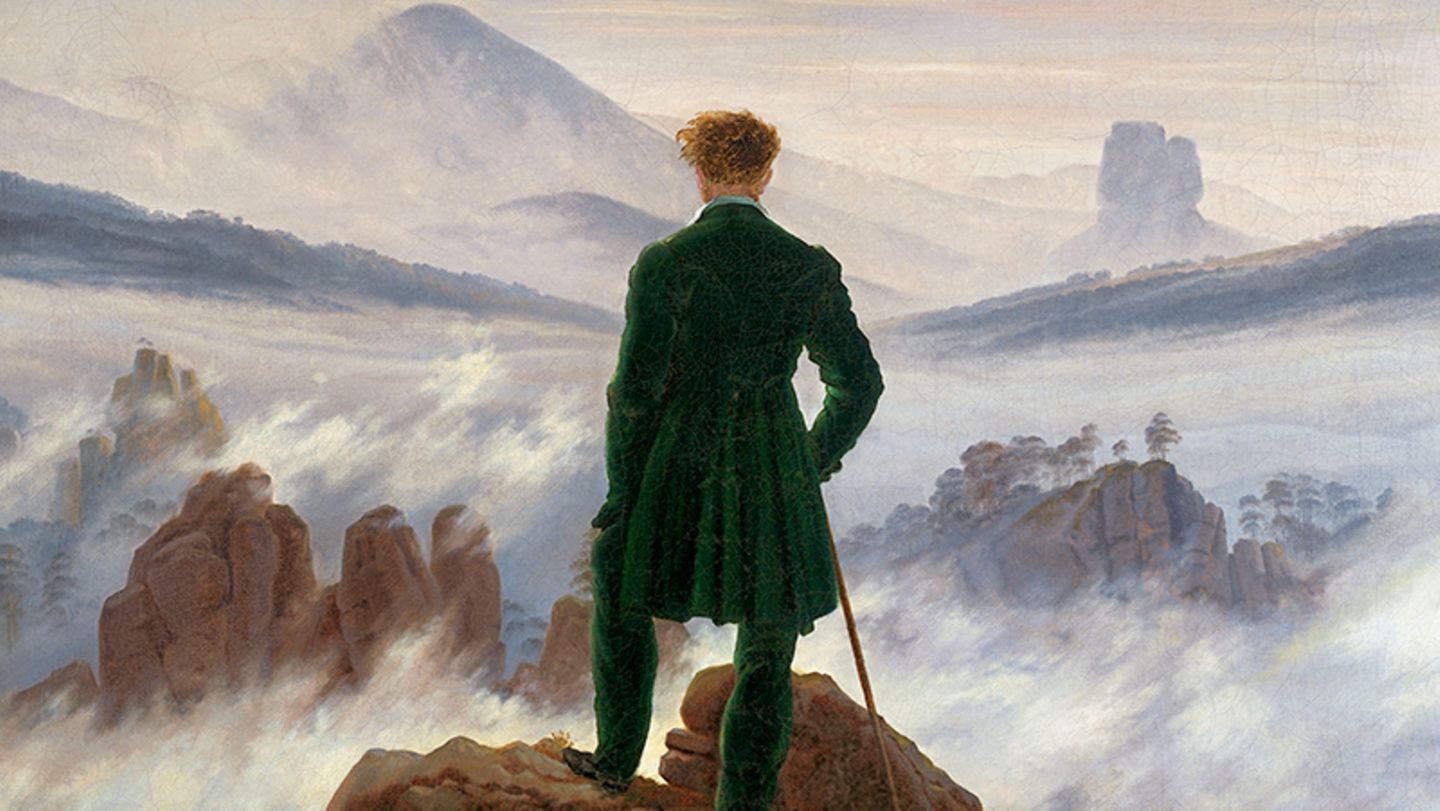
The most famous example is Wanderer above the Sea of Fog.
A man stands on a rocky summit while mountains and cliffs emerge through mist below.
The figure occupies the foreground with confidence, yet the landscape extending beyond him is immeasurable and partly hidden.
The painting can be interpreted as triumph, uncertainty, spiritual reflection, isolation, or confrontation with the unknown.
Its power depends on the inability to resolve these possibilities completely.
The man appears elevated above nature while simultaneously being overwhelmed by it.
This tension lies at the center of Romantic ideas about the sublime.
The sublime describes an experience in which beauty is mixed with fear, scale, danger, or awareness of forces beyond human control.
Friedrich’s mountains, seas, storms, ice fields, and vast skies create exactly this condition.
Nature attracts viewers while reminding them of their limitations.
Monk by the Sea, painted between 1808 and 1810, pushes this idea toward radical simplicity.
A tiny dark figure stands before an enormous sea and sky.
There is almost no conventional foreground architecture, narrative action, or picturesque framing.
The composition is divided into broad horizontal zones.
The human figure appears almost insignificant.
The Alte Nationalgalerie identifies Monk by the Sea and Abbey in the Oakwood as perhaps the most famous pair of paintings from German Romanticism and describes them as profound visual formulas addressing knowledge and faith, nature and the divine, life and death.
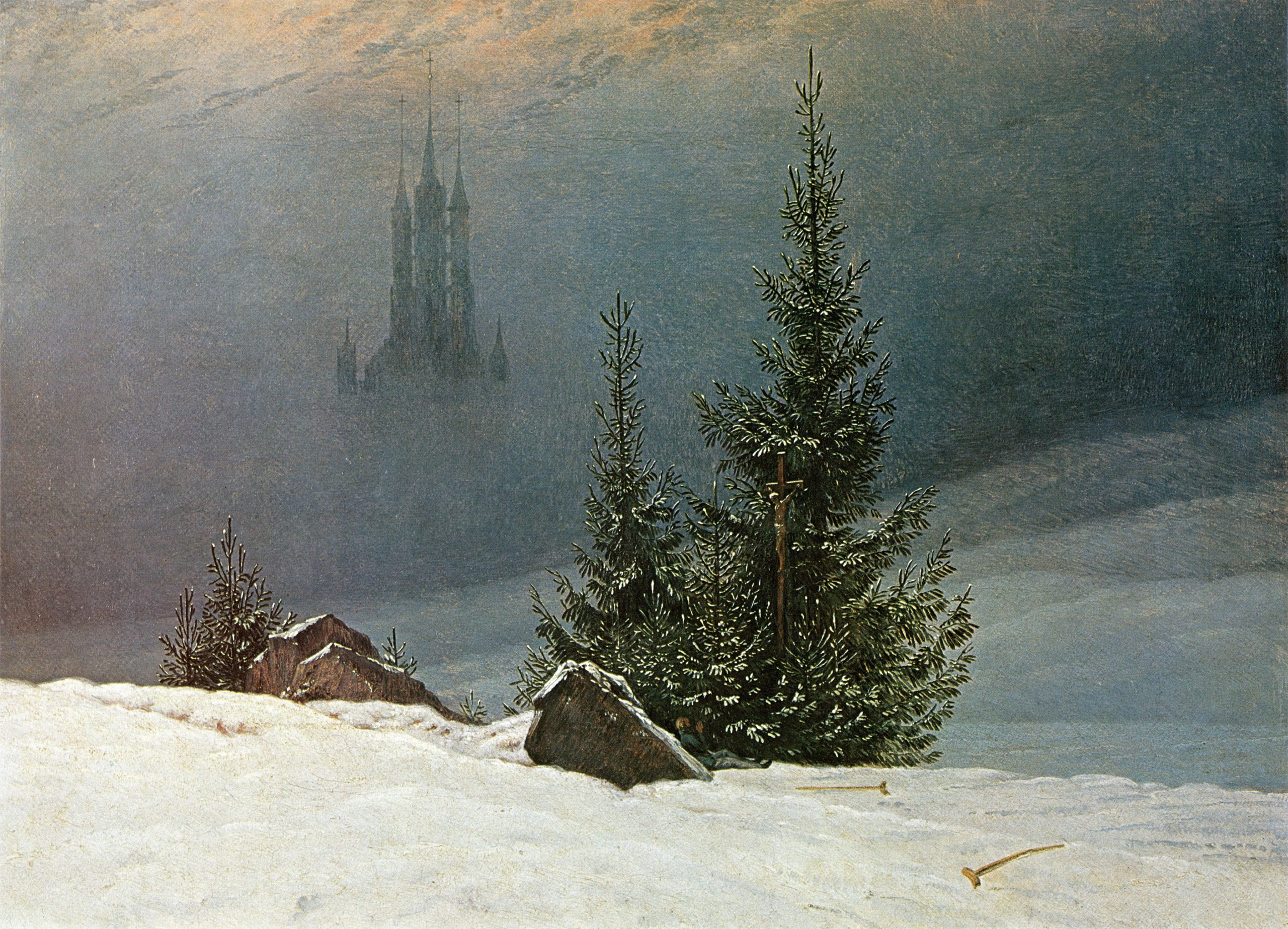
In Abbey in the Oakwood, monks move through a winter landscape carrying a coffin toward the ruins of a Gothic church.
Bare trees rise like enormous vertical structures while architectural remains suggest a civilization disappearing into nature.
The scene connects death with religious continuity and historical decay.
Friedrich’s ruins rarely function simply as picturesque reminders of the past.
They emphasize time.
Human institutions appear temporary beside trees, rocks, mountains, and cycles of seasons.
Gothic architecture carries additional spiritual and cultural meaning.
Churches, abbeys, crosses, and cathedral-like trees suggest a relationship between landscape and religious experience.
Friedrich believed that nature could become a site of spiritual revelation.
Yet his paintings rarely provide simple certainty.
Crosses can be distant. Churches can be ruined. Figures may face enormous empty space.
Faith exists beside doubt.
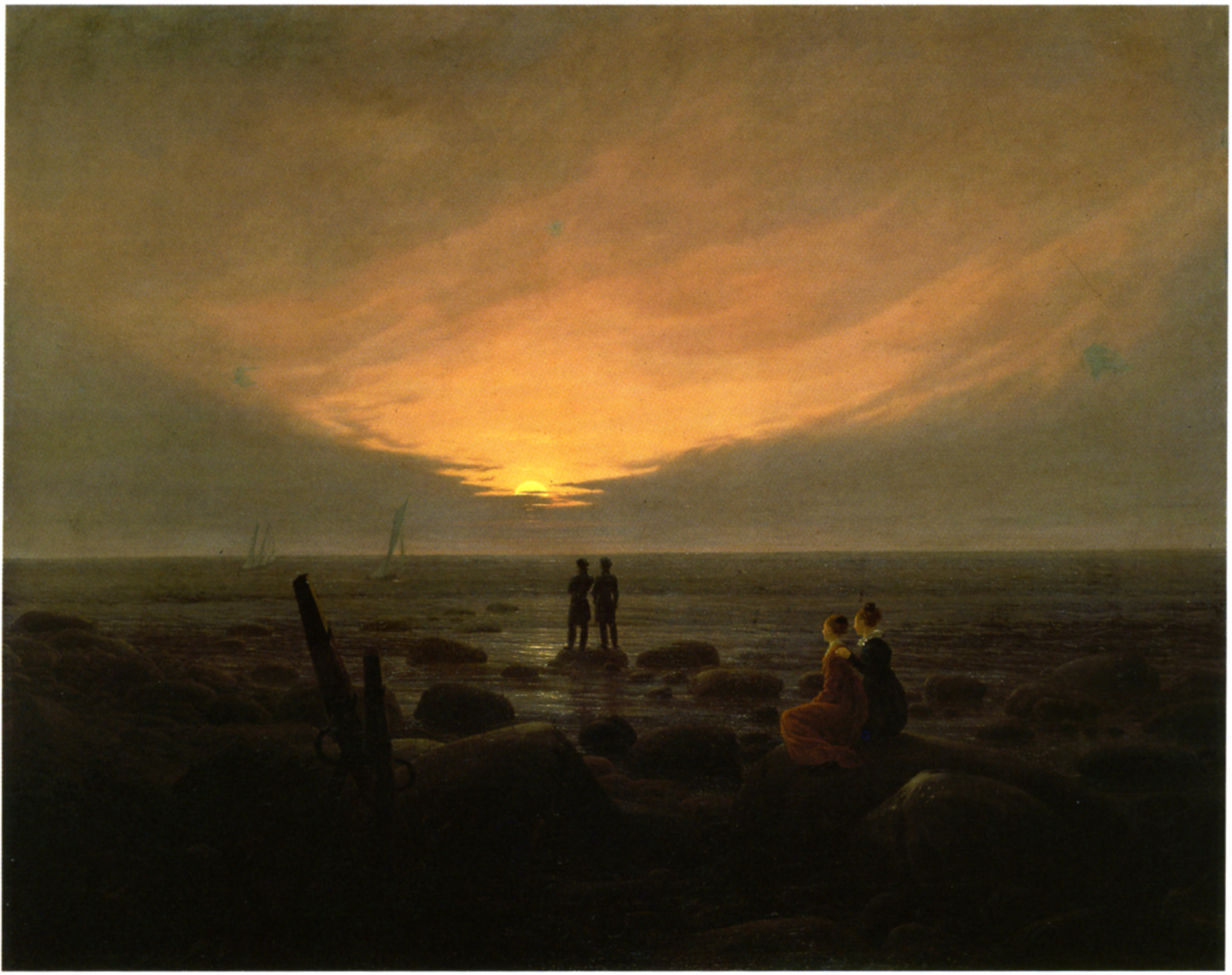
Moonlight became another recurring subject.
Friedrich painted couples and small groups observing the moon, including several versions of the famous theme known as Two Men Contemplating the Moon. The Metropolitan Museum of Art identifies versions dating from approximately 1819 through around 1830.
The figures stand together beneath trees, looking toward a crescent moon.
The scene is intimate but expansive.
Two individuals share one act of looking, connecting human companionship with cosmic distance.
Moonlight also transforms ordinary landscape into unfamiliar visual territory.
Colors become restricted, forms partially disappear, and darkness creates uncertainty.
Friedrich’s coastal paintings draw upon the Baltic environments of his youth.
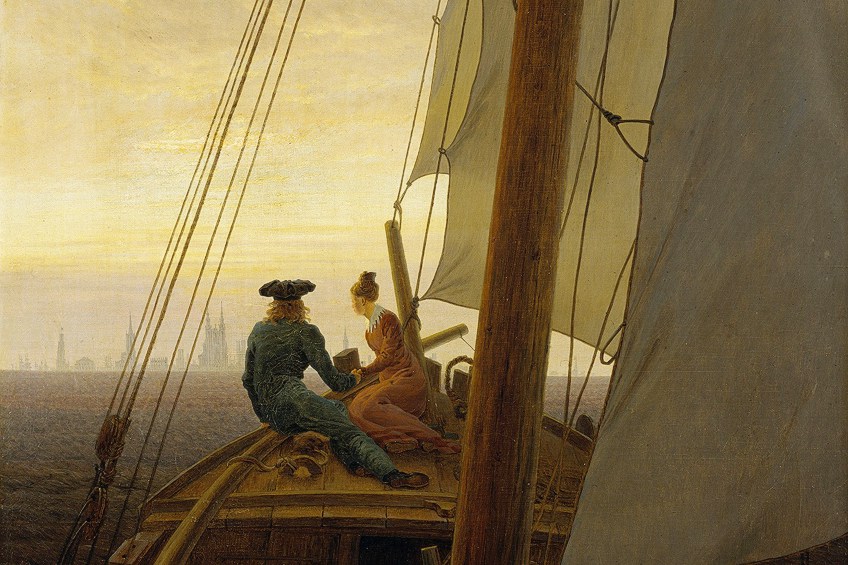
Ships frequently function as symbols of departure, return, time, death, or human destiny.
A ship moving toward the horizon can suggest life traveling into uncertainty.
A ship approaching shore may imply return.
In The Stages of Life, figures of different ages occupy the shore while ships at different distances correspond loosely with phases of human existence. The work is among the internationally recognized late paintings highlighted in the Alte Nationalgalerie’s major Friedrich retrospective.
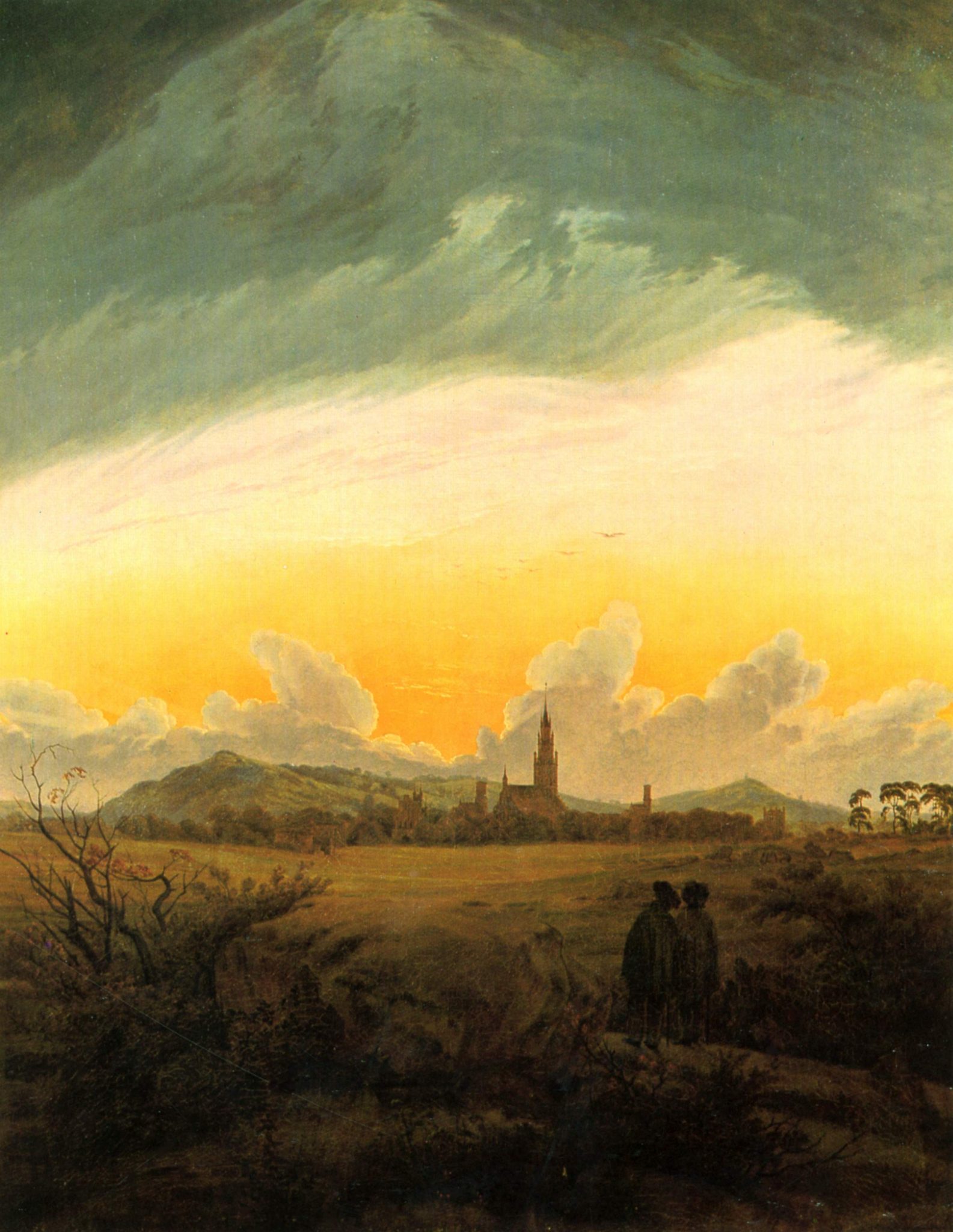
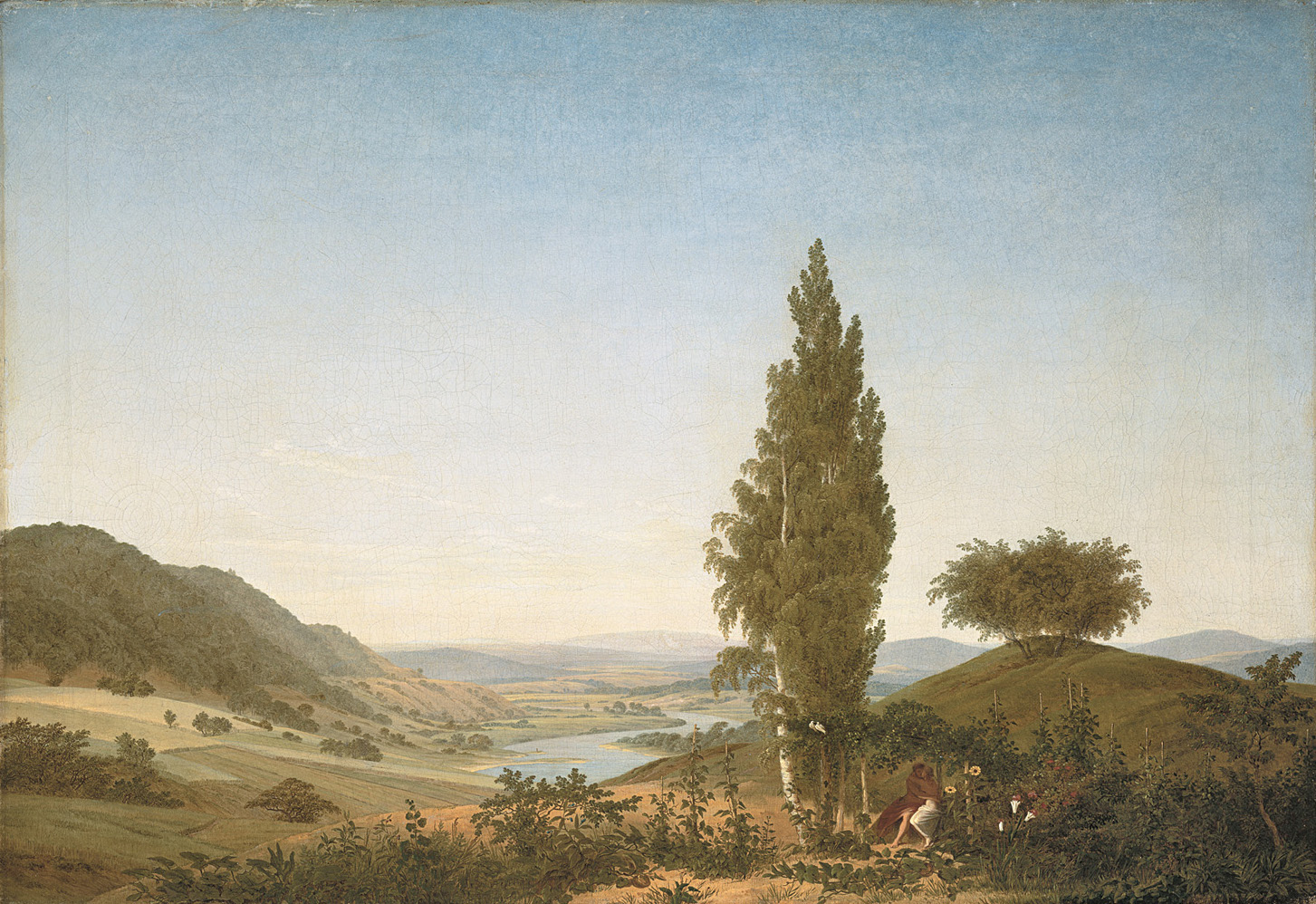
Seasonal cycles perform similar symbolic functions.
Snow, dead trees, spring vegetation, evening light, and changing weather become ways of thinking about mortality and renewal.
Winter is especially significant.
Snow removes visual detail and reduces the landscape to strong contrasts.
Trees become skeletal structures, while human tracks may appear temporary against the larger environment.
Friedrich’s The Sea of Ice, also known as The Arctic Ocean, represents one of the most extreme visions of nature in nineteenth-century painting.
Broken sheets of ice rise into an enormous chaotic structure.
A wrecked ship is almost swallowed by the environment.
Human technology has failed completely.
There is no dramatic rescue, heroic survivor, or comforting narrative.
Nature dominates.
The painting feels startlingly modern because the composition approaches abstraction.
Sharp planes of ice create a violent geometric structure while still remaining recognizable as landscape.
Friedrich’s paintings were initially admired by important contemporaries, but his reputation declined later in his life.
Changing artistic tastes, political circumstances, and the emergence of new forms of realism contributed to his increasing isolation.
After his death in 1840, his work was neglected for decades.
The Nationalgalerie played a major role in Friedrich’s rediscovery in the early twentieth century, a history emphasized in its 2024 exhibition marking the 250th anniversary of his birth.
This rediscovery transformed his position in art history.
Modern audiences recognized qualities that earlier viewers had overlooked.
His empty spaces anticipated modern minimalism.
His isolated figures spoke to existential experience.
His constructed landscapes felt psychologically contemporary.
His use of scale influenced photography, cinema, and visual culture far beyond Romantic painting.
Friedrich has become especially important to contemporary discussions about humanity and the environment.
His work does not treat nature merely as property, scenery, or resource.
The landscape remains independent of human desire.
Mountains do not care whether a traveler reaches the summit. Ice destroys technology. Forests outlive buildings.
This relationship gives the paintings new relevance in an age defined by ecological uncertainty.
At ArtExpoWorld, we consider Caspar David Friedrich one of the artists who most profoundly changed the meaning of landscape painting.
Before Friedrich, landscape could function as background, decoration, topographical record, or idealized scenery.
In his hands, it became philosophical space.
A mountain could represent ambition and uncertainty.
A ruined church could represent faith and historical disappearance.
A moon could connect two human figures with infinity.
A tiny monk facing the sea could embody the entire question of what it means to stand inside a universe that exceeds human understanding.
Caspar David Friedrich’s landscapes remain powerful because they refuse to tell viewers exactly what to think.
They create silence.
And inside that silence, the landscape becomes a mirror for whatever the viewer brings to it.