




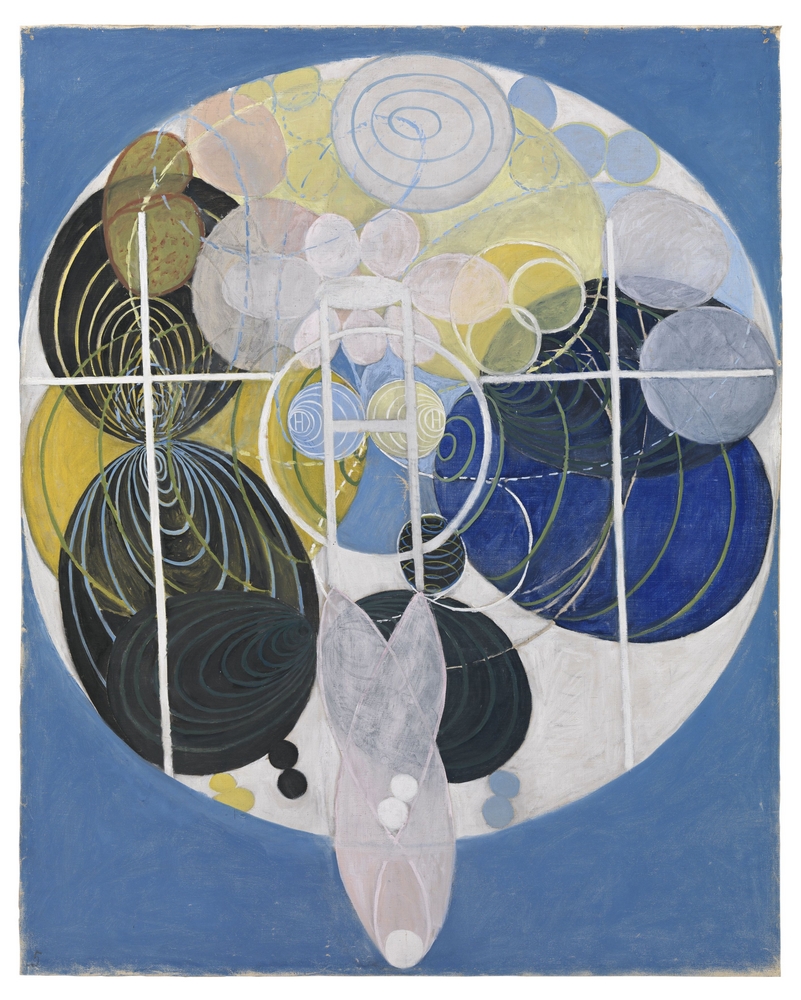
Hilma af Klint was a Swedish artist whose monumental paintings radically changed the accepted history of abstraction. Decades before many celebrated modernists abandoned recognizable imagery, she created vast compositions built from circles, spirals, botanical forms, letters, geometric structures, and luminous fields of color.
Born in 1862, af Klint developed two artistic careers that existed side by side. Publicly, she was a professionally trained painter who produced portraits, landscapes, botanical studies, and naturalistic works. Privately, she created an extraordinary abstract universe connected with spirituality, scientific inquiry, philosophy, and her attempt to visualize realities beyond ordinary perception.
Af Klint grew up in a family connected with naval service, mathematics, navigation, and cartography. She spent part of her childhood close to nature and developed a lasting interest in plants, animals, and the structures of living organisms.
Her early drawings demonstrate careful observation. Flowers, leaves, shells, and organic systems were not merely decorative subjects. They offered visible evidence of patterns that seemed to connect individual life with larger universal processes.
Af Klint studied at Stockholm’s Royal Academy of Fine Arts during the 1880s, graduating with honors. Unlike many women of her generation, she received formal training and gained access to a professional studio.
She exhibited conventional paintings and earned income through portraiture and landscape work. This public career confirms that her later abstraction did not result from an inability to paint realistically. She deliberately moved beyond representation after mastering it.
The late nineteenth century was a period of intense cultural transformation. Discoveries involving electricity, radio waves, X-rays, evolution, and microscopic life suggested that reality contained forces invisible to the naked eye.
At the same time, spiritualism, Theosophy, Rosicrucianism, and other esoteric movements attracted people searching for ways to reconcile religion with modern science. Af Klint participated deeply in this environment.
In 1896, she joined four other women to form a spiritual group known as The Five. The members met regularly for prayer, meditation, séances, automatic writing, and collective drawing.
They believed they were receiving messages from spiritual beings or higher levels of consciousness. Whatever interpretation viewers place on these experiences today, the meetings gave the women an experimental space outside the conventions of academic culture.
Automatic drawing allowed lines and forms to develop without being fully planned in advance. The process weakened the authority of conscious control and created unexpected combinations of symbols, language, and organic shapes.
These collective experiments preceded similar techniques later associated with Surrealism. For af Klint, however, automatic creation was not primarily a method of releasing personal desire. It was part of a disciplined attempt to receive and organize knowledge.
In 1906, she began the project that became known as The Paintings for the Temple. The complete cycle eventually included nearly two hundred works produced across several years and divided into interconnected groups and series.
Af Klint understood these paintings as parts of a unified spiritual architecture. She imagined that they might one day be displayed inside a spiral-shaped temple where viewers would move through different levels of knowledge.
No such building was constructed during her lifetime, but the architectural idea influenced the scale and organization of the paintings.
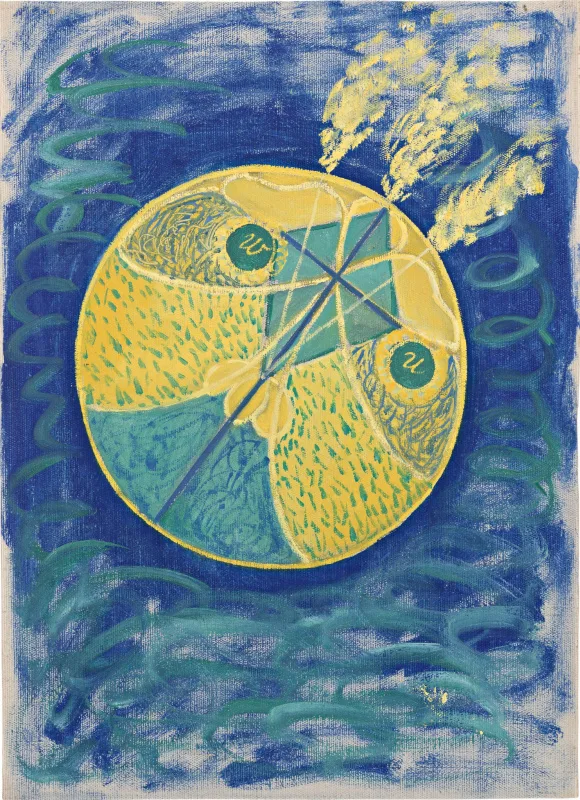
The series Primordial Chaos contains small works filled with spirals, circles, written letters, shells, sperm-like forms, and divided fields of blue and yellow. The images suggest creation, polarity, reproduction, matter, and spiritual evolution.
Symbols recur across the paintings but rarely have only one meaning. A spiral can represent growth, movement, development, or the connection between physical and spiritual realities. A shell may suggest organic life as well as an inward journey.
Blue and yellow often appear as opposing forces. Af Klint sometimes connected them with male and female principles, although their meanings shift across the larger system. Pink, orange, violet, green, black, and white create additional relationships between matter, spirit, age, and transformation.
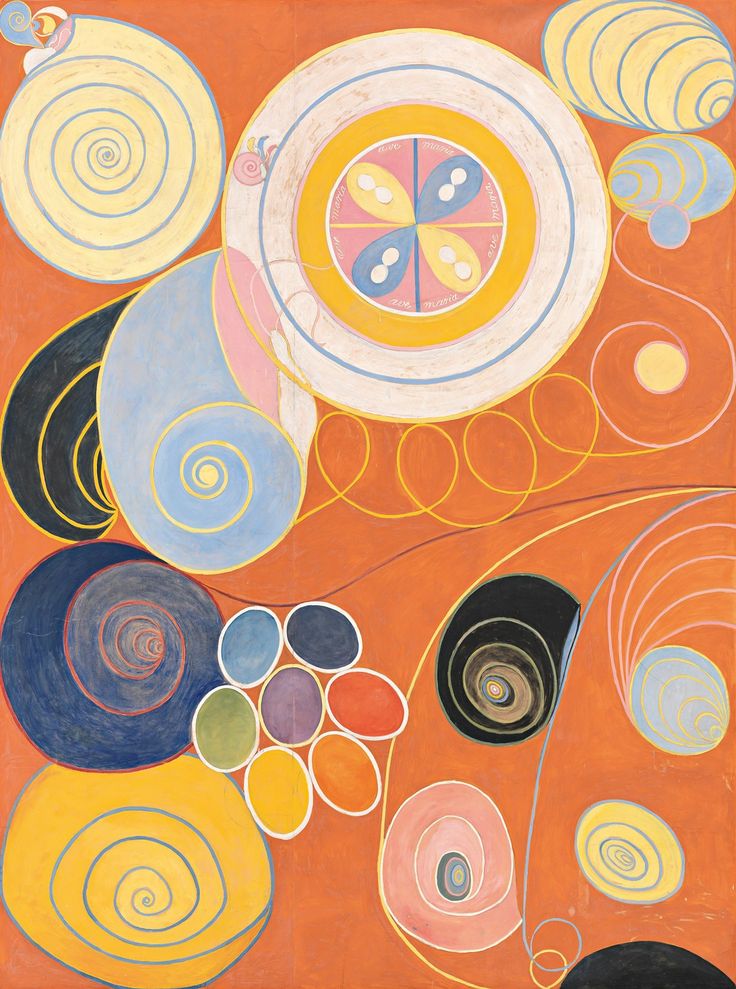
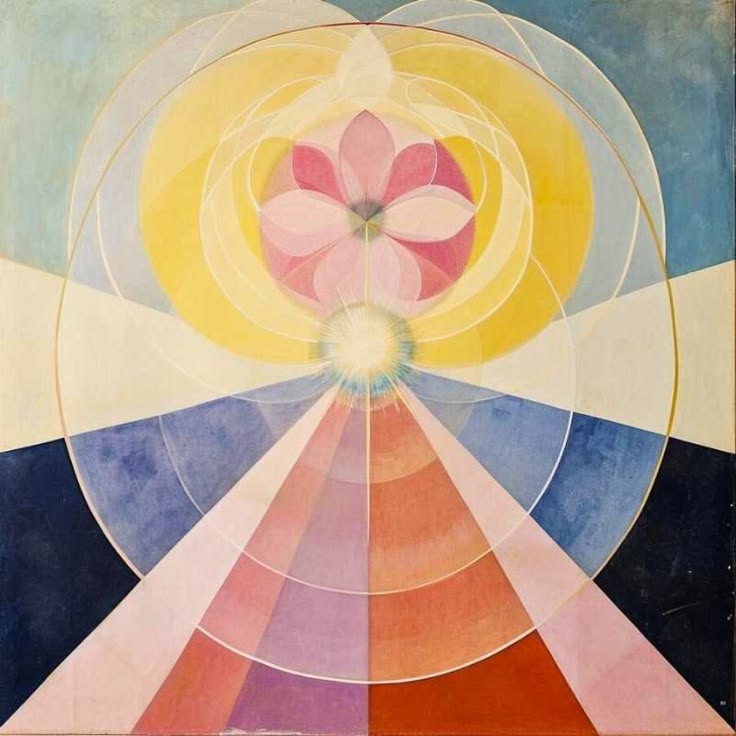
Her most celebrated series, The Ten Largest, was created in 1907. Ten monumental canvases represent stages of human life from childhood and youth to adulthood and old age.
The scale was extraordinary, particularly for a woman working at the beginning of the twentieth century. Flowers, spirals, circles, curves, and written signs float across pink, blue, orange, and yellow backgrounds.
The paintings feel playful and expansive, but their subject is the entire human life cycle. Individual identity disappears into a larger rhythm of growth, maturity, aging, and return.
Af Klint worked rapidly on the series, sometimes using assistants and painting directly onto paper later mounted on canvas. The speed and physicality of the process are visible in the broad shapes and hand-drawn lines.
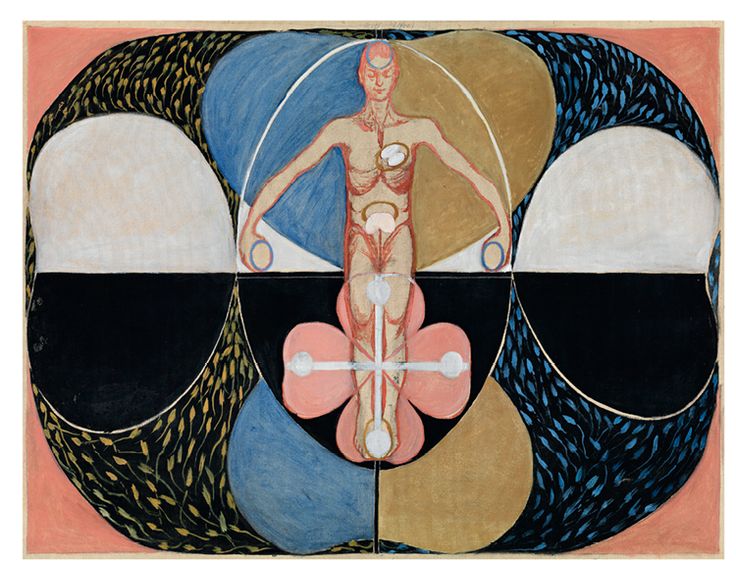
Later groups within The Paintings for the Temple became more geometric and symmetrical. Squares, circles, triangles, crosses, and carefully balanced divisions replaced some of the earlier organic movement.
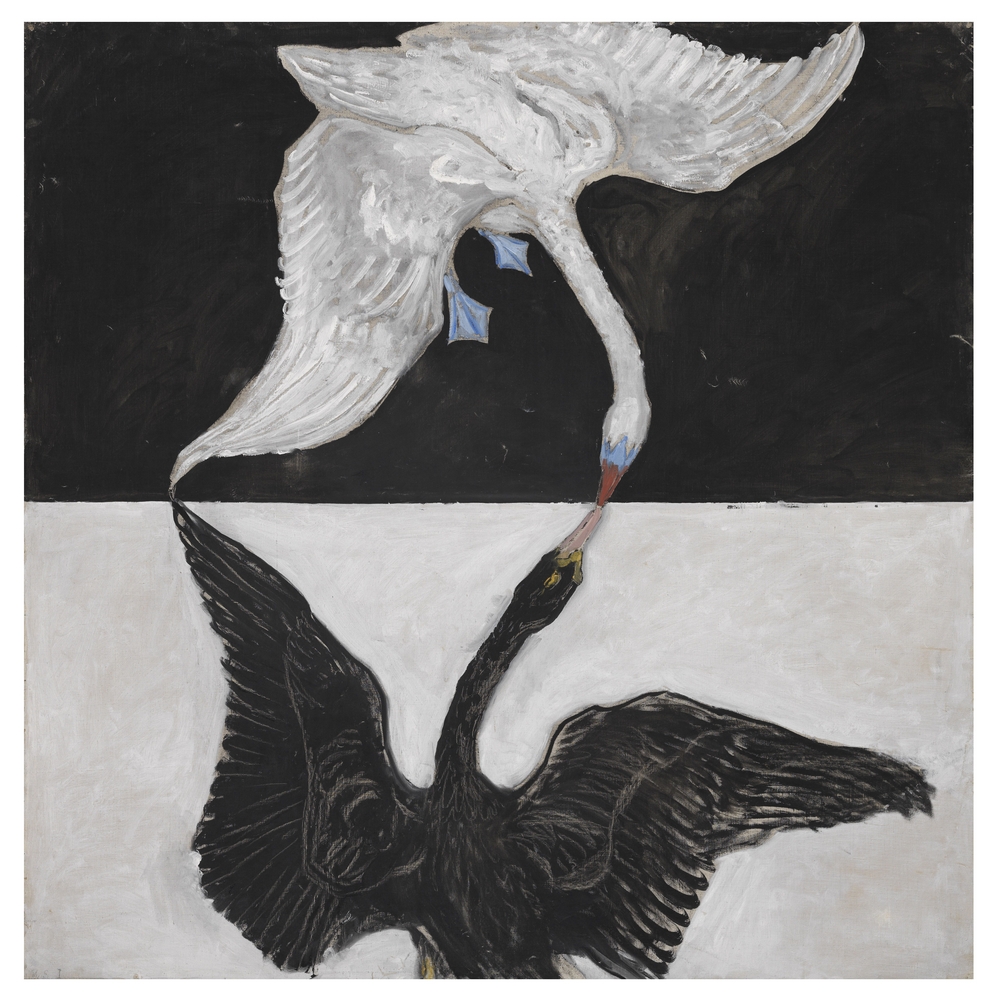
In The Swan, black and white birds initially face one another across a divided field. As the series continues, the swans transform into increasingly abstract geometric structures.
The sequence moves from recognizable creatures toward pure form, presenting abstraction as a process of transformation rather than a sudden rejection of nature.
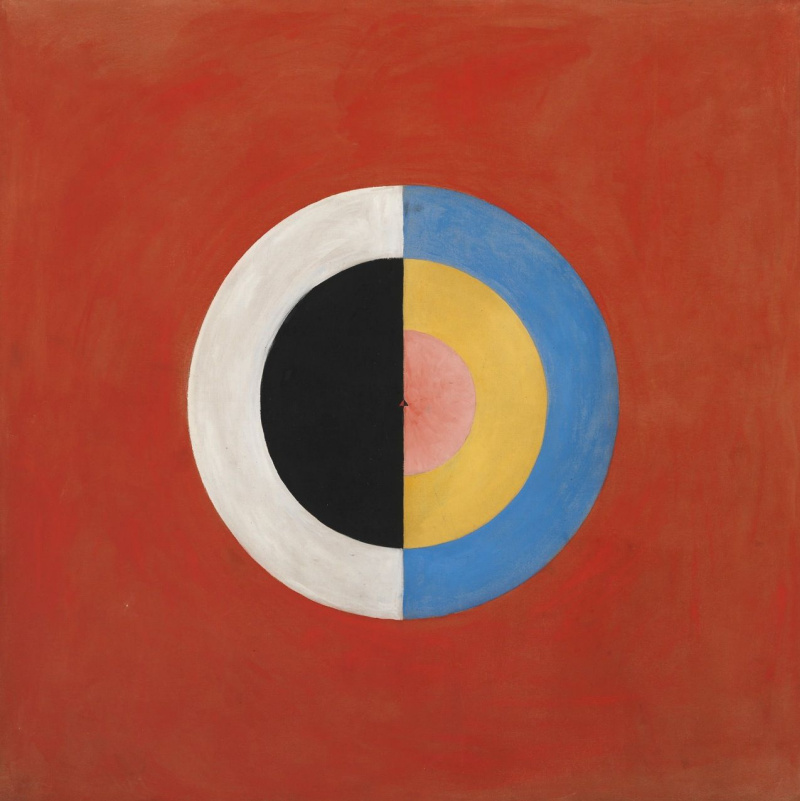
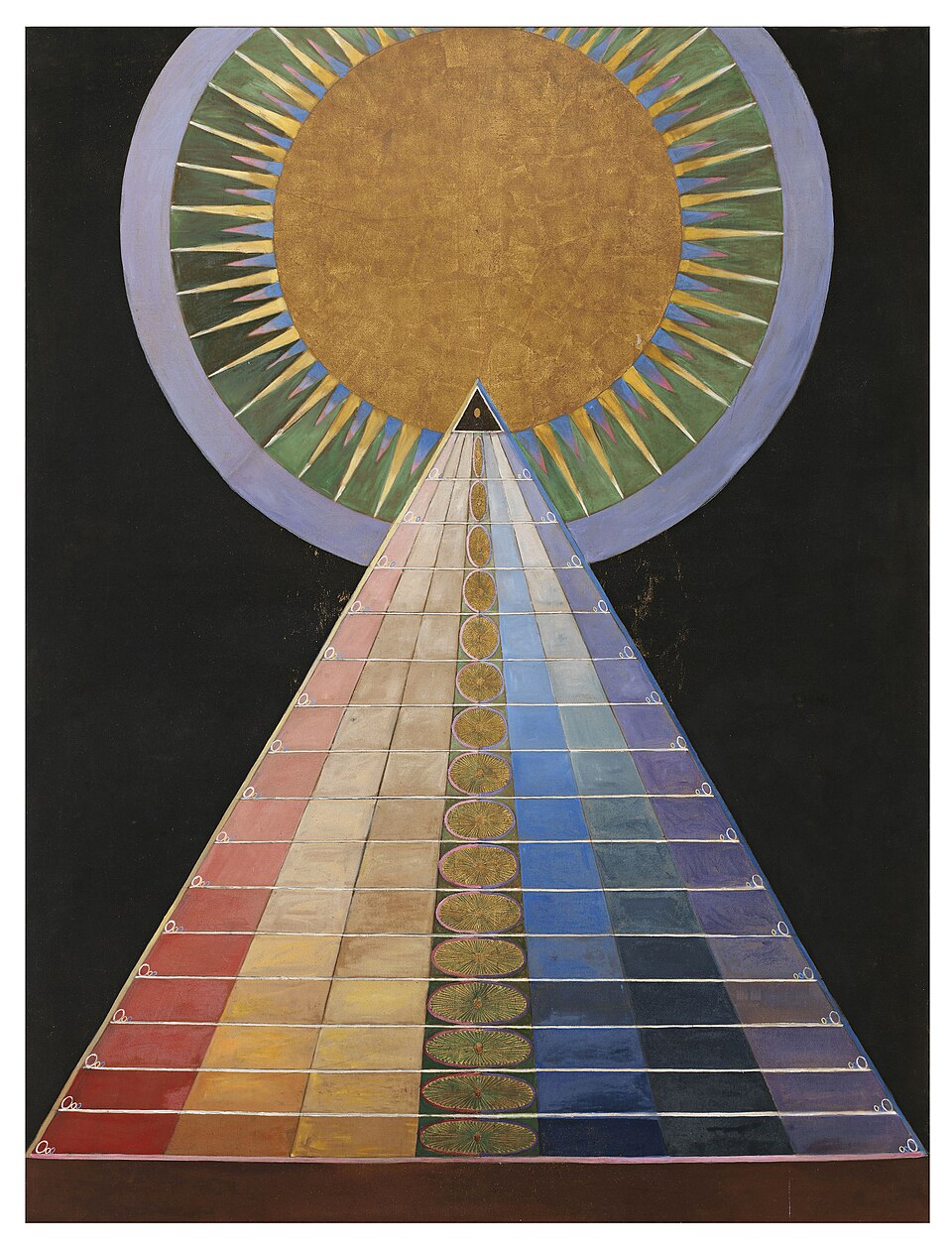
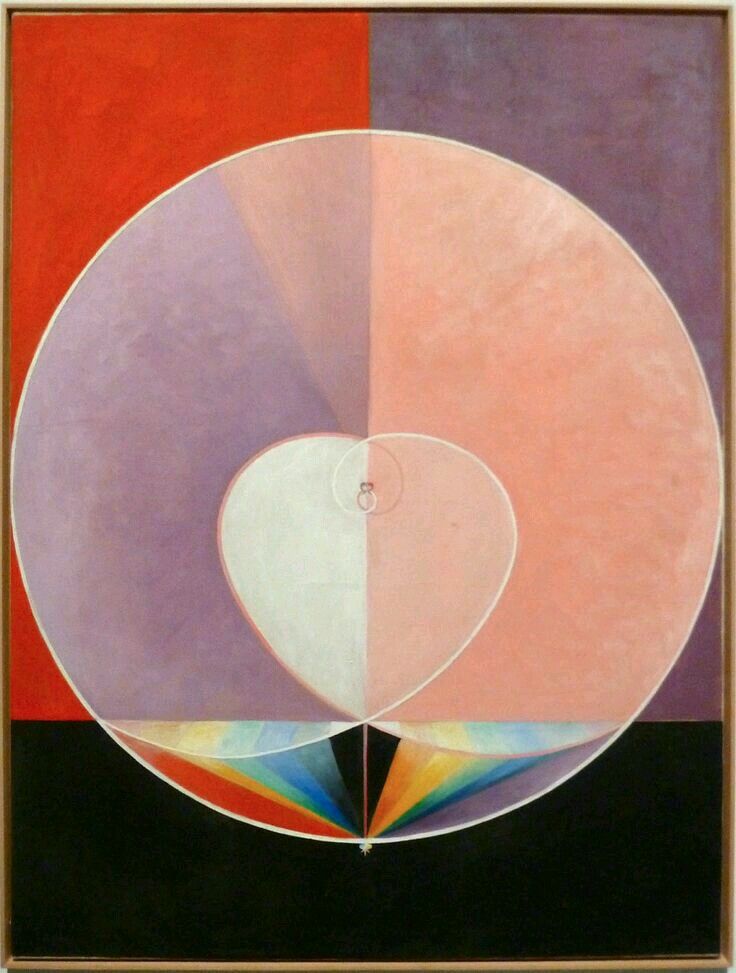
The Altarpieces bring the temple cycle toward a monumental conclusion. Triangles, circles, radiant color, and dark fields create images that suggest ascent, descent, unity, and spiritual hierarchy.
Their geometry is precise, but the paintings do not feel cold. Color gives the structures emotional and symbolic intensity.
Af Klint filled thousands of notebook pages with diagrams, interpretations, invented words, religious ideas, observations, and attempts to organize her visual system. Her art cannot be separated from this extensive written archive.
She did not create isolated abstract compositions for decorative effect. Each painting belonged to an evolving intellectual and spiritual project.
Her position within the history of abstraction requires nuance. Af Klint produced major nonfigurative paintings before the canonical abstract works of Wassily Kandinsky, Kazimir Malevich, and Piet Mondrian.
This chronology makes her a crucial pioneer, but her importance should not be reduced to a competition over who was ‘first.’ Her art emerged from different motivations and developed largely outside the networks that shaped the public history of European modernism.
Unlike many avant-garde artists, af Klint did not aggressively promote her abstract work through manifestos, commercial galleries, or major exhibitions. She believed its meaning might not be understood by her contemporaries.
Her conventional paintings were exhibited, but the abstract and esoteric works remained largely private or were shown only within limited spiritual contexts.
Af Klint died in 1944, leaving her artistic archive to her family. She expected later generations to be better prepared to understand the project, and decades passed before the abstract paintings received major public attention.
An important turning point came in 1986, when her work appeared in the Los Angeles County Museum of Art exhibition The Spiritual in Art: Abstract Painting 1890–1985. This placed her within a broader history connecting modern abstraction with spiritual and esoteric thought.
International interest grew gradually through exhibitions, publications, films, and scholarly research.
The 2018–2019 Guggenheim exhibition Hilma af Klint: Paintings for the Future introduced her work to an enormous audience and became the most highly attended exhibition in the museum’s history at that time.
The architecture of the Guggenheim seemed unexpectedly close to the spiral temple af Klint had imagined. Visitors moved through a rising circular space while encountering works originally designed as parts of a spiritual journey.
Her rediscovery also raised important questions about how art history is constructed. Why had a professionally trained woman who created monumental abstraction before many famous male modernists remained outside the standard narrative?
Part of the answer lies in gender, but other factors were equally important. Her paintings were not widely exhibited, her spiritual beliefs fell outside dominant interpretations of modernism, and the works remained in family care rather than circulating through influential commercial and museum systems.
Today, af Klint’s imagery feels strikingly contemporary. Her combinations of botanical structures, geometric diagrams, invented language, scientific forms, and spiritual symbolism resemble data visualization, systems art, ecological thinking, and digital design.
Yet the physical presence of the paintings remains essential. Their scale surrounds the viewer, while visible brushwork and irregular lines preserve the human labor behind the symbolic system.
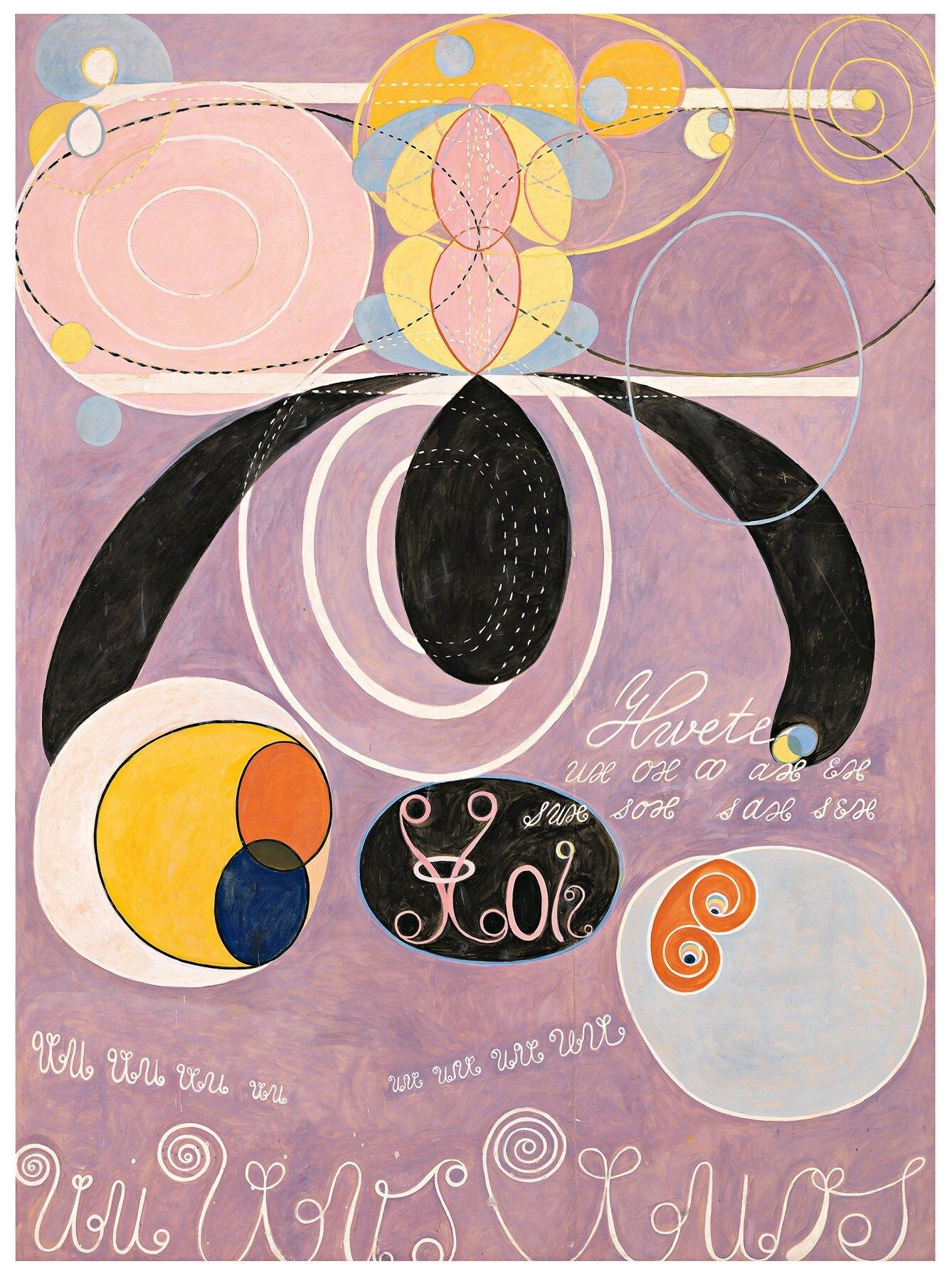
At ArtExpoWorld, we consider Hilma af Klint one of the artists who most profoundly expanded the history of modern painting. She demonstrated that abstraction could emerge from the interaction of art, nature, science, spirituality, and collective experimentation.
Her legacy is larger than the discovery of an overlooked pioneer. Af Klint challenges the idea that modernism developed through one simple sequence of famous movements and male innovators.
Her paintings reveal another history: private, collaborative, visionary, and created for an audience the artist believed had not yet arrived.